About Meloe laevis Leach, 1815
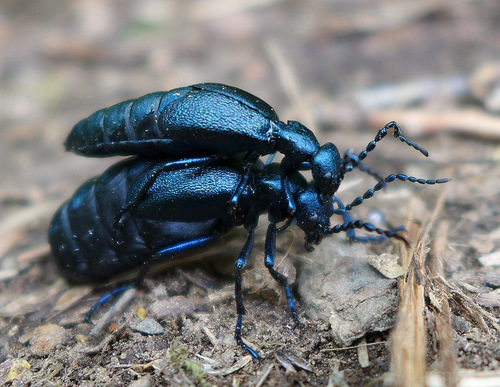
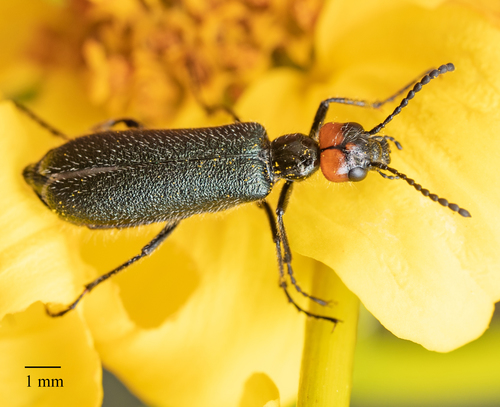
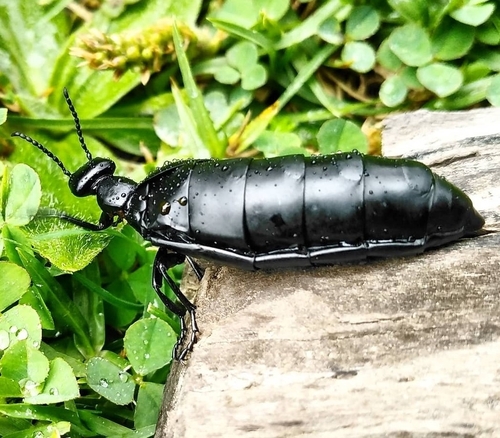
Meloe laevis, commonly called the oil beetle, is a species of blister beetle that belongs to the family Meloidae. This species is found in the Caribbean, Central America, and North America. For its life cycle, eggs of Meloe laevis typically hatch during the summer. Like all other species in the genus Meloe, the behavior and development of newly hatched larvae of this species is notable, as they undergo hypermetamorphosis. Tiny freshly hatched Meloe laevis larvae have a specific common name: triungulin, and they can also be referred to by the more general term planidium. After emerging from the ground, the triungulin climbs onto a flower and waits for a bee. When a bee arrives, the triungulin climbs onto the bee. If the host bee is male, the larva stays with the male until he mates, at which point the triungulin transfers onto the female bee. If the triungulin originally boarded a female bee, the female will unwittingly carry the larva back to her underground nest. Once inside the nest, the triungulin develops into a grub-like, inactive form that feeds on both the bee's developing larvae and the stored food intended for the bee's own larvae. Eventually, the developing larva metamorphoses into a pupa, which later metamorphoses into a fully mature adult oil beetle. Any given Meloe species may parasitize only a single bee species or genus, or may use multiple different bee species.