About Meloe brevicollis Panzer, 1793
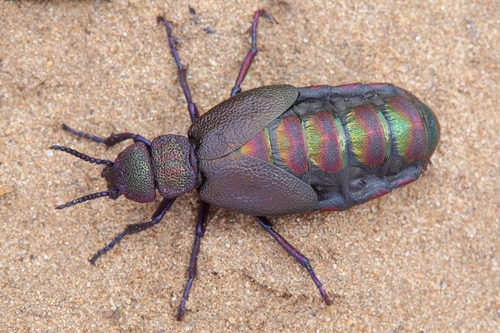
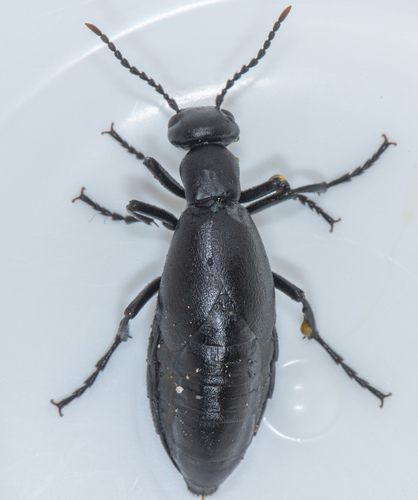
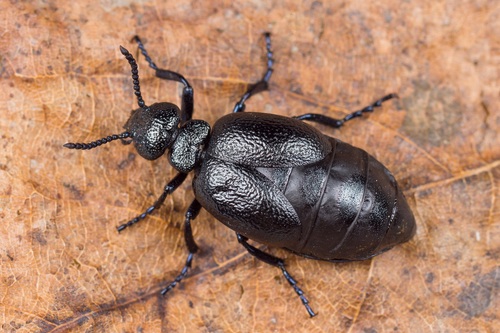
Meloe brevicollis is a European oil beetle, commonly called the short-necked oil beetle. It was widely believed to have gone extinct in the United Kingdom by the 1940s, a decline attributed to intensive farming. A small population of the species was unexpectedly discovered in south Devon in 2007. In 2010, 40 individual beetles were found across four sites on Coll, a Hebridean island. This beetle is flightless, and its young are parasitic, relying on solitary nesting bees to survive. This biology leaves an open question about how the species reached the island of Coll. Jeanne Robinson, curator of entomology at Glasgow Museums, noted that the species is very vulnerable to habitat disturbance, and both the Devon and Coll sites share the key trait of having remained relatively undisturbed for a long period. She added that researchers hope to conduct genetic analysis to determine the origin of the island population. There are historical records of this beetle from Ireland, so it is possible the Coll colony dispersed from an Irish population. In 2014, staff from RSPB Scotland and Buglife visited Coll to conduct a thorough survey for the beetle. During this work, the team found more than 150 beetles, and identified two previously unknown sites for the species on the island. This discovery confirmed Coll as the most important site for Meloe brevicollis in the United Kingdom. In 2020, the species was rediscovered in Pembrokeshire, Wales; it had not been recorded in this area since 1944.