About Mellivora capensis (Schreber, 1776)
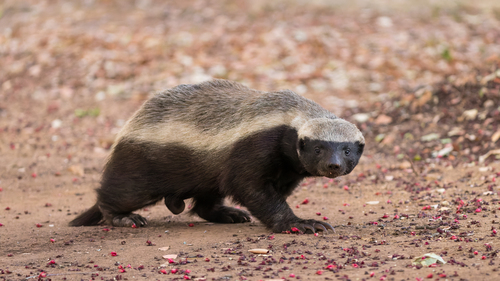
The honey badger (Mellivora capensis, first described by Schreber in 1776) has a fairly long body that is distinctly thick-set and broad across the back. Its skin is remarkably loose, which lets the animal turn and twist freely within it. The skin around the neck is 6 mm (0.24 in) thick, an adaptation for fighting other honey badgers. Its head is small and flat, with a short muzzle; eyes are small, and ears are little more than ridges on the skin, another possible adaptation to avoid damage during fights. The honey badger has short, sturdy legs, with five toes on each foot. Its feet have very strong claws: claws are short on the hind legs and remarkably long on the forelimbs. It is a partially plantigrade animal, with soles that are thickly padded and naked up to the wrists. The tail is short, covered in long hairs, except for the area below its base. The honey badger is the largest terrestrial mustelid in Africa. Adults measure 23 to 28 cm (9.1 to 11.0 in) in shoulder height and 55–77 cm (22–30 in) in body length, with the tail adding an additional 12–30 cm (4.7–11.8 in). Females are smaller than males. In Africa, males weigh 9 to 16 kg (20 to 35 lb) on average, while females weigh 5 to 10 kg (11 to 22 lb) on average. Multiple studies report that the mean weight of adult honey badgers from different regions falls between 6.4 to 12 kg (14 to 26 lb), with a median of roughly 9 kg (20 lb). This places it as the third largest known badger, after the European badger and hog badger, and the fourth largest extant terrestrial mustelid, after also including the wolverine. However, the average weight of three wild females from Iraq was reported as 18 kg (40 lb), which is around the typical weight of male wolverines or male European badgers in late autumn, indicating honey badgers can reach much larger sizes than typical when conditions are favorable. By contrast, an adult female and two males in India were relatively small, weighing 6.4 kg (14 lb) with a median of 8.4 kg (19 lb). Skull length is 13.9–14.5 cm (5.5–5.7 in) in males and 13 cm (5.1 in) for females. The honey badger has two pairs of mammae, and an eversible anal pouch, a trait it shares with hyenas and mongooses. The smell of the pouch is reported to be "suffocating", and may help calm bees when the honey badger raids beehives. The honey badger skull greatly resembles a larger version of the marbled polecat skull. Its dental formula is 3.1.3.1 / 3.1.3.1. Teeth often show signs of irregular development, with some teeth being exceptionally small, set at unusual angles, or absent entirely. Honey badgers of the subspecies signata have a second lower molar on the left side of their jaws, but not the right. Although it feeds mostly on soft foods, the honey badger's cheek teeth are often extensively worn. Canine teeth are exceptionally short for a carnivore. The papillae of the tongue are sharp and pointed, which helps process tough foods. Winter fur is long, measuring 40–50 mm (1.6–2.0 in) long on the lower back. It consists of sparse, coarse, bristle-like hairs, with minimal underfur. Hairs are even sparser on the flanks, belly and groin. Summer fur is shorter, only 15 mm (0.59 in) long on the back, and even sparser, with the belly being half bare. The sides of the head and lower body are pure black. A large white band covers the upper body, running from the top of the head to the base of the tail. Honey badgers of the cottoni subspecies are unique in being completely black. The honey badger's range covers most of sub-Saharan Africa, from the Western Cape, South Africa, to southern Morocco and southwestern Algeria. Outside Africa, it ranges through Arabia, Iran, and Western Asia to Turkmenistan and the Indian Peninsula. It has been recorded from sea level up to 2,600 m (8,500 ft) in the Moroccan High Atlas and 4,000 m (13,000 ft) in Ethiopia's Bale Mountains. Across its range, the honey badger is found predominantly in deserts, mountainous regions and forests. These habitats can have annual rainfall as low as 100 mm in dry, arid regions, and as high as 2,000 mm. The honey badger is mostly solitary, but has also been observed hunting in pairs in Africa. It uses old burrows dug by aardvarks and warthogs, as well as termite mounds, for shelter. In Serengeti National Park, honey badger activity levels depend largely on the time of year: in the dry season, it is mostly nocturnal, while in the wet season it remains active throughout the day, reaching peak activity during crepuscular hours. A study in India's Sariska Tiger Reserve concluded the honey badger is highly nocturnal, and a study in the Cauvery Wildlife Sanctuary found similar results. The honey badger is a skilled digger, able to dig tunnels into hard ground in 10 minutes. These burrows usually have only one entry, are typically only 1–3 m (3 ft 3 in – 9 ft 10 in) long, and have an unlined nesting chamber. Adult honey badgers occupy a home range. Females establish a large home range whose size changes primarily based on food abundance, and particularly when rearing young. Males have considerably larger home ranges that depend on the availability of females in heat, which often means a male's home range overlaps with that of around 13 females. Adult males have an average home range of 548 km2 (212 sq mi), compared to an average of 138 km2 (53 sq mi) for females. Research suggests adult males have a dominance hierarchy, while females tend to avoid contact with each other, displaying less pronounced territorial behavior even though female home ranges overlap by 25%. Wild honey badgers have been confirmed to scent-mark while squatting, and this behavior is thought to be an important form of communication. They frequently scent-mark their territories with anal gland excretions, feces and urine. According to personal accounts, captive honey badgers scent-mark in a squatting position, releasing fluid from their anal glands. The honey badger is well known for its strength, ferocity and toughness. When escape is impossible, it is known to savagely and fearlessly attack almost any other species, and has even been reported to repel much larger predators such as lions and hyenas. In some cases, honey badgers deter large predators by releasing a pungent yellow liquid from their anal glands. They pair this with a threat display that includes rattling noises, goosebumps, a straight upward-facing tail, and general charging behavior while holding their heads up high. A 2018 study found that the presence of large predators had no effect on honey badger populations in the Serengeti. This likely indicates that honey badgers seek areas similar to those preferred by larger predators, and may occupy a similar ecological niche. Bee stings, porcupine quills, and animal bites rarely penetrate their thick loose skin. If horses, cattle, or Cape buffalos enter a honey badger's burrow, the honey badger will attack them. In Cape Province, the African leopard and Southern African rock python are potential predators of the honey badger. The honey badger's call is a hoarse "khrya-ya-ya-ya" sound. When mating, males make loud grunting sounds. Cubs vocalize through plaintive whines, and when confronting dogs, honey badgers scream like bear cubs. The honey badger does not have a specific mating season, and breeds at any time of year. Females have an estimated oestrus period of about 14 days. Their gestation period is thought to last 50–70 days, usually producing one to two cubs that are born blind and hairless. Females give birth in a den, and transport their young from one shelter to another for the first three months. When foraging, females leave their cubs and return to the den to suckle them. Sightings of females suckling young are generally rare, but one observation recorded a female suckling her young outside the den, lying supine with the cub sitting atop her abdomen in an upside-down orientation. At about three to five weeks of age, cubs begin developing the adult black-and-white coat. At eight to twelve weeks, they follow their mother on foraging trips, and weaning occurs during this period. On average, females stay with their cubs for 1–1¼ years, during which they teach cubs important life skills such as climbing, foraging and hunting. Not all cubs survive to adulthood. One study recorded a 37% cub mortality rate in Kgalagadi Transfrontier Park, caused by predation, infanticide and starvation. While the exact age when males reach sexual maturity is uncertain, multiple lines of evidence indicate they reach sexual maturity at two to three years of age. The age when females reach sexual maturity is also uncertain, but they are thought to become sexually mature when they become independent, with the strongest indicator being that females migrate outside their mother's range not long after separation. The lifespan of the species in the wild is unknown, but captive individuals have been known to live for approximately 24 years.