About Melitaea phoebe (Denis & Schiffermüller), 1775
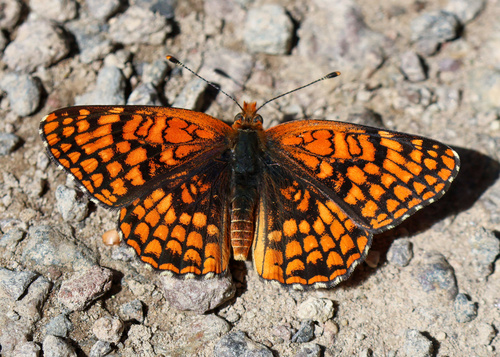
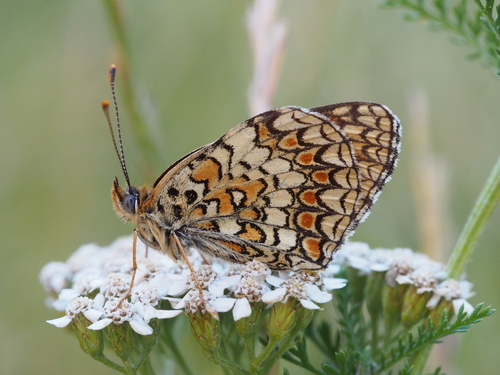
Butterflies of Melitaea phoebe have a wingspan ranging from 34 to 50 mm. Their forewings are more pointed than those of the eastern knapweed fritillary, while both species are equally variable in color and distinctive markings. The black markings on M. phoebe wings are usually joined, but can cover most of the wing or very little of it instead. This species has a reddish-yellow, crescent-shaped (lunate) submarginal spot between the two median veins that reaches its vertex considerably further into the disc than the other yellow lunate spots. This marking pattern appears on both the forewings and hindwings. In addition, the submarginal lunule between the first and second median veins projects further toward the base of the wing than the other lunules in the same row. A short description of this species was published by Wheeler in 1903. The pupae of M. phoebe are dull yellow-brown, with dark yellow and black markings. The larvae are grey with a black head, soft red-brown branched thorns, blackish dorsal lines, and many small white dots. Melitaea phoebe occurs across most of Europe, excluding northern regions including England, Ireland, Northern France, Germany, Poland, Holland, Belgium, and Scandinavia. It is also found in North Africa (specifically Morocco and Algeria), Turkey, Siberia, and Central Asia including Mongolia and northern China. M. phoebe lives in flowery meadows and plains, and may also be found in stonier areas such as rocky hills.