About Melitaea cinxia Linnaeus, 1758
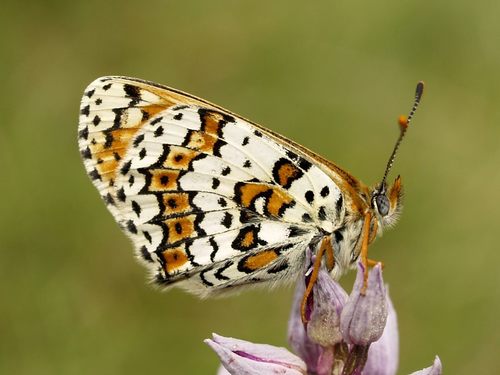
Melitaea cinxia, commonly called the Glanville fritillary, has a wingspan of approximately 33 to 40 millimetres (1.3 to 1.6 inches). These are medium-sized butterflies with orange, black, and white checkerspot pattern on their forewings. The upper side of their hindwings bears a row of black dots. The hindwings have white and orange bands with a series of black dots inside these bands, and these markings are also clearly visible on the reverse side of the wing. Females are typically more dull in color than males, and have more developed black dots. As described in Seitz, M. cinxia is uniformly pale yellowish red on the upper wing surface, marked with black in a pattern somewhat resembling a chessboard, with checkered white fringes. A row of heavy black dots in the submarginal row of spots on the hindwing is a characteristic feature of the species. Except for the pale yellow, black-dotted apex, the underside of the forewing is uniformly reddish leather-yellow, with scattered black spots that vary in number. Despite having a wide distribution, the species has not developed many distinct races. Caterpillars reach about 25 mm in length, with a reddish-brown head, a spiny black body, and small white dots. Melitaea cinxia is quite similar to the heath fritillary (Melitaea athalia), but the beige and orange bands on M. cinxia’s underwings are distinctive. Additionally, heath fritillary has no spots on the upperside of its hindwings. The Glanville fritillary occurs across Europe and temperate Asia. It is most common on Åland, Finland, where it occupies a network of around 4,000 dry meadows, which is the fritillary’s ideal habitat. These butterflies typically live in open grassland at elevations between 0 and 2,000 metres (0 to 6,562 ft) above sea level. A female Glanville fritillary can lay up to 10 clutches of eggs over her lifetime. Each clutch contains between 50 and 300 eggs, and females lay the clutches on the underside of leaves of their larval food plants, which are either Plantago lanceolata (ribwort plantain) or Veronica spicata (spiked speedwell). After hatching, the caterpillars feed on their host plants until the end of summer, when they spin a "winter nest" to diapause. When winter ends, they emerge from the nest to feed again, before pupating around the start of May. Adult fritillaries emerge one month later, and spend their adult lives feeding, mating, and laying eggs.