About Melilotus officinalis (L.) Lam.
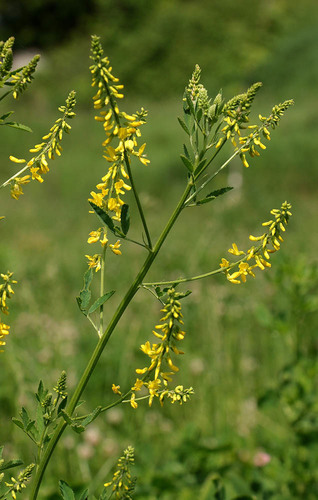
Melilotus officinalis (L.) Lam. may be an annual or biennial plant, reaching 120–180 centimetres (4–6 ft) in height when mature. Its leaves grow alternately along the stem, and each leaf holds three leaflets. Yellow flowers bloom during spring and summer, and produce fruit in pods that usually contain one seed each. Melilotus officinalis seeds can remain viable for up to 30 years. This plant species has large taproots and typically grows in groups, and it has a distinct characteristic sweet odor. Ribbed melilot (Melilotus officinalis) looks very similar to other melilot species, especially tall melilot. It can be distinguished by its ribbed, glabrous (hairless) fruits, its more broadly oval upper leaflets, and its lower petal (called the keel), which is slightly shorter than its side petals. In tall melilot, the keel and side petals are the same length. Melilotus officinalis is native to Europe and Asia, and was introduced to North America as a forage crop. It grows most commonly in calcareous loam and clay soils with a pH above 6.5. It can tolerate cold temperatures and drought, but cannot tolerate standing water or acidic soils; the lowest soil pH it can tolerate is 5.5. It is most often found in open disturbed land, prairies, and savannahs, and grows in full or partial sunlight. In regions where it has been introduced, it is an invasive species. It is especially invasive in open grasslands and woodlands, where it shades native plants and outcompetes them for resources. Game birds including grouse eat the seeds of Melilotus officinalis. When properly cured, sweetclover can be used as pasture or livestock feed. It is most palatable in spring and early summer, but livestock often need time to adjust to the bitter taste of coumarin contained in the plant. Before World War II, before commercial agricultural fertilizers became widely used, this plant was commonly grown as a cover crop to increase nitrogen content and improve subsoil water capacity in poor soils. It is the most drought-tolerant of all commercially available legumes. Sweet clover is a major source of nectar for domestic honey bees; hives located near sweetclover stands can produce up to 200 pounds of honey per year. Sweetclover has been used as a phytoremediation phytodegradation plant to treat soils contaminated with dioxins. In the chemical industry, dicoumarol is extracted from this plant to manufacture rodenticides.