About Melilotus indicus (L.) All.
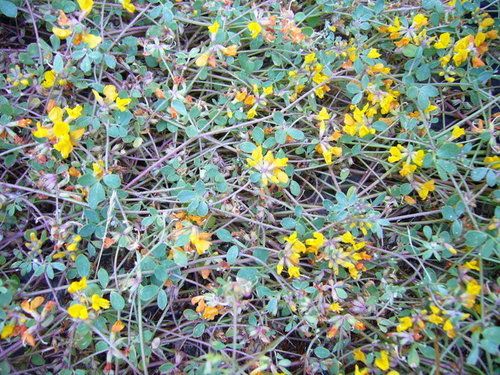
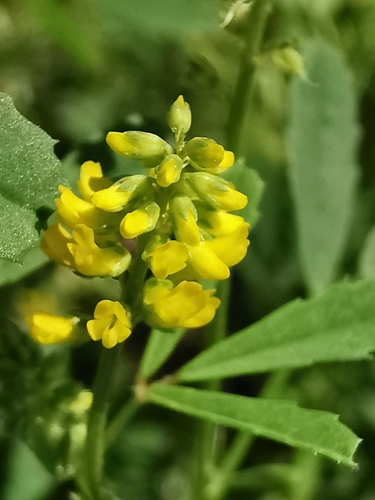
Melilotus indicus (L.) All. is an annual or biennial herb that grows 10 to 50 centimetres (3.9 to 19.7 inches) tall, and rarely reaches one meter in height. It produces trifoliate leaves made up of three leaflets. Its small yellow flowers measure 2–3 mm, and are borne in dense racemes. After flowering, it forms hairless seed pods of a similar length to the flowers. When crushed, its leaves release a sweet, cloying scent.
This species has a broad native distribution that spans from Macaronesia and northern Africa, through Europe, and into temperate and tropical Asia. It is naturalized across most of the rest of the world, including the United Kingdom, the United States, South America, Australia and New Zealand. In regions where it has been introduced, it is commonly found in fields, along roadsides, and in other disturbed areas, and is usually classified as a weed. Melilotus indicus is a confirmed halophyte, and maintains high germination and growth rates when growing in saline substrates. Its main salt tolerance mechanism is salt inclusion, which lets the plant accumulate high levels of salt ions.
Species in the Melilotus genus are typically pollinated by insects. This plant is used as a nectar source for bees, as livestock forage, and as a soil improver thanks to its nitrogen-fixing properties. As a salt-tolerant species, it works as a particularly useful forage crop in areas where other legumes cannot grow. By 1907, it was already being used as cattle fodder on King Island, which explains its common Australian name. Melilotus indicus has been used in traditional medicine for its analgesic, antioxidant, aperitive, emollient, and anti-inflammatory properties. Plants of the Melilotus genus contain coumarins, which are compounds with anticoagulant properties. Extracts of Melilotus indicus have been shown to have cytotoxic effects against multiple types of cancer cells.