About Melierax metabates Heuglin, 1861
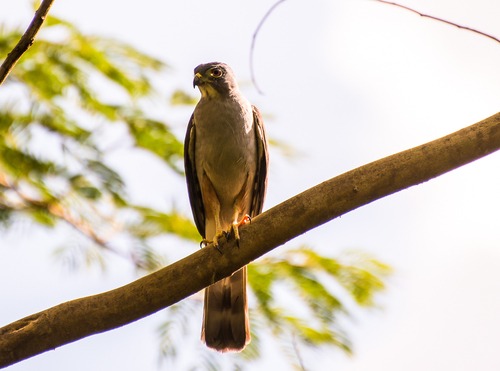
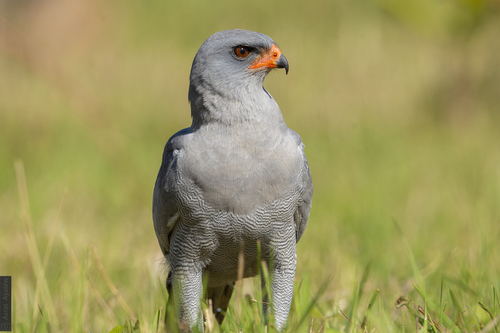
The dark chanting goshawk (Melierax metabates Heuglin, 1861) is a medium-sized, bulky hawk that holds an upright stance. Its head, breast, and upperparts are primarily dark grey. The underparts below the breast are white and finely barred with black. The wing primaries are black, and the tail has broad black and white bars. Its cere and long legs are orange-red. On average, females are larger than males: females reach a maximum weight of 840g, while males reach a maximum weight of 700g. Juveniles typically have browner plumage that matches the color and pattern of buzzards in the Buteo genus, but retain the broad-winged, long-tailed silhouette of an accipiter. The dark chanting goshawk breeds across sub-Saharan Africa, but avoids the rainforests of the Congo Basin and the far southern part of the region, where it is replaced by the pale chanting goshawk. In east Africa, it is replaced by the eastern chanting goshawk. Five subspecies are currently recognised, though the status of M. m. neumanni is debatable because it is poorly differentiated from other subspecies. The recognised subspecies are: Melierax metabates metabates, found from Senegal and the Gambia east to Ethiopia, and south to the Democratic Republic of the Congo and northern Tanzania; Melierax metabates neumanni, found from Mali east to northern Sudan; Melierax metabates theresae, found in south west Morocco; Melierax metabates ignoscens, found in south western Arabia, specifically south western Saudi Arabia and western Yemen; and Melierax metabates mechowi, found from south eastern Gabon to Angola, and from south Tanzania south to northern Namibia and north eastern South Africa. This species occurs in savannahs and open woodlands, and favors mixed bushveld and broad-leafed woodlands. It avoids dense forest and desert. Where it overlaps with other Melierax species, the dark chanting goshawk prefers moister, richer woodland. In southern Africa, it is found in tall, well-developed woodland, especially where miombo (Brachystegia spp), mopane (Colosphermum mopane), Zambezi teak (Baikiaea plurijuga), Knob thorn (Senegalia nigrescens) and Marula (Sclerocarya birrea) grow in the canopy.