About Melicytus lanceolatus Hook.fil.
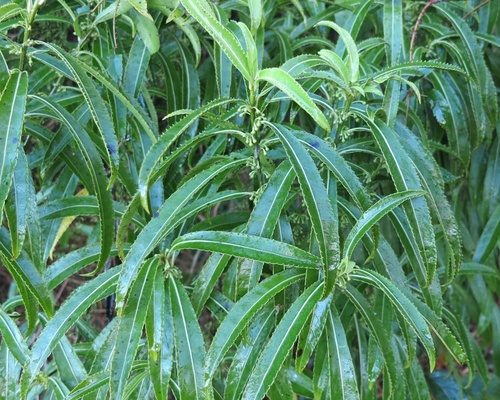
Melicytus lanceolatus Hook.fil. is a small, typically slender, erect, glabrous tree. It can reach a maximum height of 5–6 m, with a trunk up to 30 cm in diameter. Its vibrant green leaves are simple, alternate, and have finely serrated margins. Leaves are lanceolate (long, thin, and narrow), measuring 5–16 cm long by 0.5–2 cm wide. The leaf tip occasionally curves downward, and this combination of features makes the leaves of this species strongly resemble willow leaves. The bark is brown to white, slightly wrinkled, and marked with prominent lenticels, and its branches are brittle. Its flowers are small, 5 mm in diameter, with five erect petals that curve backward. Petal color varies, and may be yellow, dark purple, or show hints of both colors. Flowers grow in clusters of two to five, along bare branches below the leaves, and occasionally from leaf axils. Clusters can be so numerous that they densely cover branches in small flowers. The flowers are fragrant, and produce scent both day and night. This species produces round, dark purple berries that are 4–6 mm in diameter. There is currently disagreement over the number of seeds per berry, with sources citing either three to six seeds or six to twelve seeds. Melicytus lanceolatus is endemic to New Zealand. Within New Zealand, it occurs on the North Island, South Island, and Stewart Island, ranging from 35°30'S in the Northland region southward, from sea level up to 915 m in elevation. In the South Island, it is found mostly around Dunedin, in Southland, and west of the Southern Alps. While it does grow on Stewart Island, it is not common there. This species prefers moist, cool habitats with high rainfall, from lowland to montane forests. It tolerates a wide range of soils, but cannot tolerate dry soils. Its overall cold sensitivity is rated to –2.0 °C, matching its preference for cool areas, though its leaves have been recorded surviving frosts as cold as –8.3 °C. Melicytus lanceolatus is an early colonizing species that establishes after disturbance. It is commonly found growing along forest margins, in regenerating forest, or as a slightly shaded understory plant. As an understory species, it can tolerate shade, but it requires sufficient light for germination: seeds have been recorded to have a very low (8%) germination rate in complete darkness. It is specifically found growing in association with red beech, silver beech, kāmahi, and tōtara forests. It can also grow in shrublands, on river terraces, in inland valleys, and in frosty basins. Melicytus lanceolatus is a long-lived dioecious plant. It flowers from June to November, which spans mid-winter or early spring to early summer, and fruits from July to February, which spans late winter to late summer. Most fruits ripen between March and April. Insects are the primary pollinators of its flowers, and frugivorous birds disperse its seeds. Seeds of this species germinate after a two-month delay, typically sprouting in autumn or winter. Seeds can remain viable in soil for up to thirty months.