About Melica transsilvanica Schur
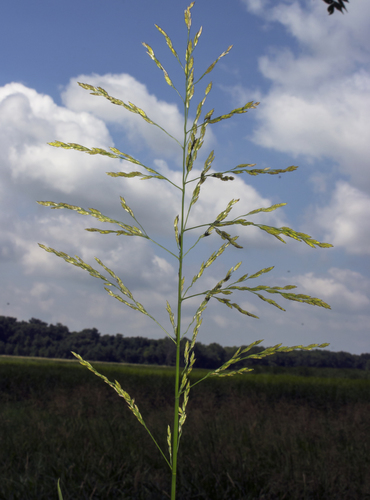
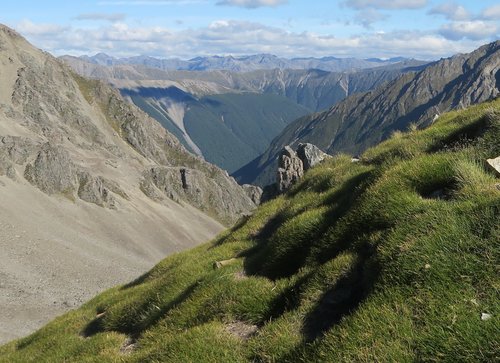
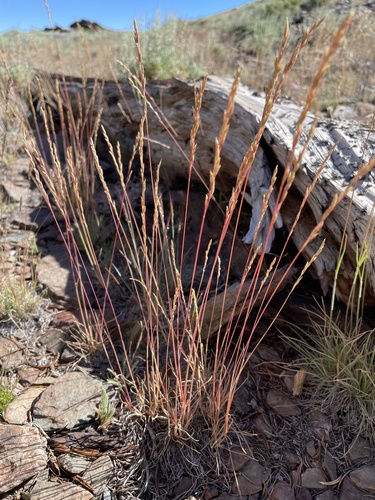
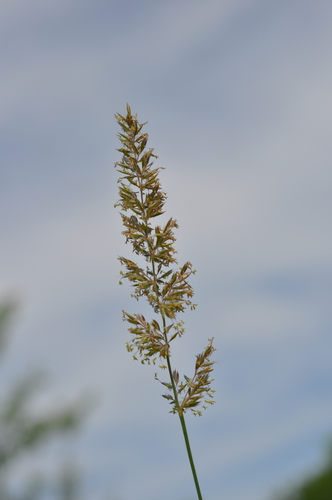
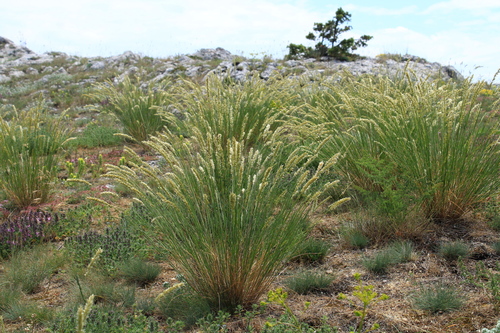
Melica transsilvanica Schur is a perennial, caespitose species with elongated rhizomes. Its culms are 40–90 centimetres (16–35 in) long, and it has tubular leaf-sheaths that are closed along part of their length. The eciliate membrane of the ligule measures 0.5 millimetres (0.020 in) long. Leaf-blades are convolute, 10–15 centimetres (3.9–5.9 in) long, 2–4 millimetres (0.079–0.157 in) wide, with a scaberulous surface that is rough on both sides. The panicle is dense, open, and linear, 4–7 centimetres (1.6–2.8 in) long and 1.5 centimetres (0.59 in) wide. Its whorled nodes are 3–8 centimetres (1.2–3.1 in) long. Fertile spikelets each contain 1 diminished fertile floret at the apex, and are borne on pedicels 1–5 millimetres (0.039–0.197 in) long. The spikelets themselves are oblong and 6 millimetres (0.24 in) long. The fertile lemma is chartaceous, elliptic, and keelless, 5 millimetres (0.20 in) long, with ciliated margins and an obtuse apex. Sterile florets are barren, clumped, and cuneate, growing in numbers of 2–3 per spikelet. Both lower and upper glumes are oblong, keelless, membranous, 5-veined, and have eroded apexes, but differ in size: the lower glume is 2–3 millimetres (0.079–0.118 in) long, while the upper glume is 5–6 millimetres (0.20–0.24 in) long. The palea is 2-veined; flowers are fleshy, oblong, and truncate, with 2 lodicules, and grow alongside 3 anthers. The fruits are caryopses with an additional pericarp and a linear hilum. In distribution, the species occurs in central Asia, specifically in Kazakhstan, Kyrgyzstan, Tajikistan, Turkmenistan, Uzbekistan, and northern Iran. It is also found in Xinjiang, China, and the Asian part of Russia. In Europe, it is present in the Czech Republic, Germany, Austria, Albania, Bulgaria, Greece, Hungary, Italy, Poland, Romania, and Switzerland. Its subspecies Melica transsilvanica transsilvanica is found only in Moldova and Ukraine. It grows at elevations of 800–2,000 metres (2,600–6,600 ft) on hills, steppes, and other dry places. Ecologically, the species is scattered throughout forested areas, and its populations prefer closed vegetation at forest margins. It grows on limestone, sandstone, basalt, granite, gypsum, porphyry, and talus.