About Melecta luctuosa (Scopoli, 1770)
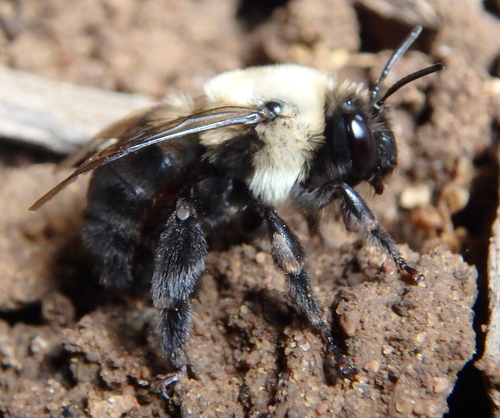
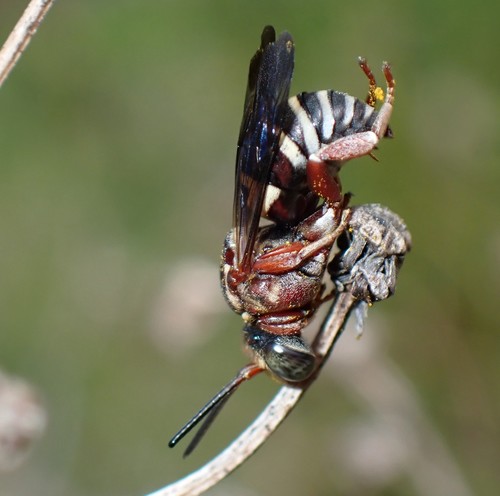
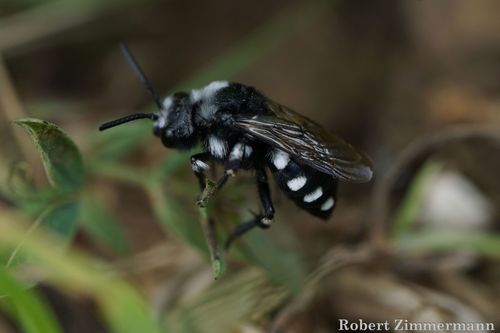
Adults of Melecta luctuosa measure 12–14 mm in length. Both males and females have black body hair with white hair patches, while the mesonotum and sides of the thorax are covered in gray hair. This species occurs across North Africa, ranging from the Canary Islands to Egypt. In Eurasia, its range extends from Portugal across Europe, through Asia Minor, the Caucasus, Central Asia, and Siberia to the Amur region; to the north it reaches southern England and southern Sweden, where it is now extirpated, as well as the Baltic States and Moscow; to the south it reaches Sicily, Crete, Cyprus, and Northern Iran. It also occurs in the Oriental faunal region in Pakistan. In central Europe, the species is currently reported from almost all regions, with only historical records from Lower Saxony, Saxony-Anhalt, Canton Vaud, and Basel. It is absent from large parts of the eastern central plateau, along the main Alpine ridge, and in the Engadine, while a reported record from the federal state of Salzburg requires verification. Its habitat includes forest fringes, hedges, steep walls, habitat edges, dry stone walls, and sand, gravel, and clay pits, and it occurs from lowland elevations up to montane elevations. Melecta luctuosa is univoltine, meaning it produces one generation per year. It is active on the wing from late April to late June, and overwinters as a mature adult (imago). It feeds on nectar from a range of plant species, including Ajuga reptans, Glechoma hederacea, Salvia pratensis, Salvia verticillata, species in the genus Nepeta, Echium vulgare, and Anchusa officinalis. Melecta luctuosa is a parasitoid cuckoo bee. Its main host is Anthophora aestivalis; other known recorded hosts are Anthophora crinipes, Anthophora plagiata, and Anthophora retusa, and it may also parasitize Anthophora fulvitarsis.