About Melanoplus differentialis (Thomas, 1865)
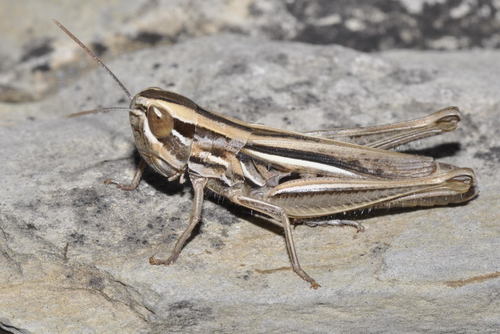
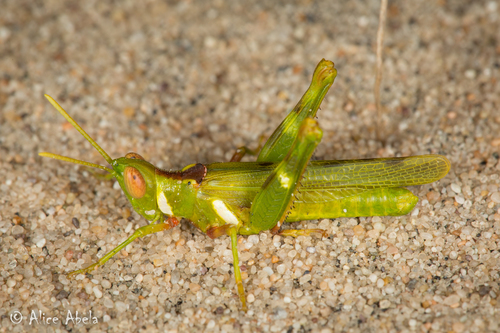
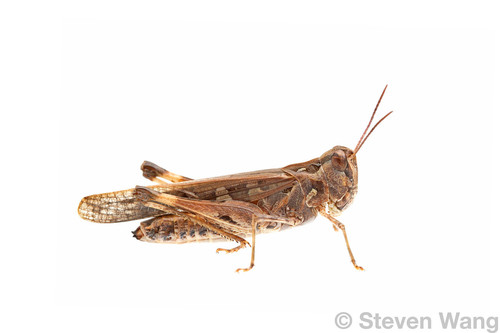
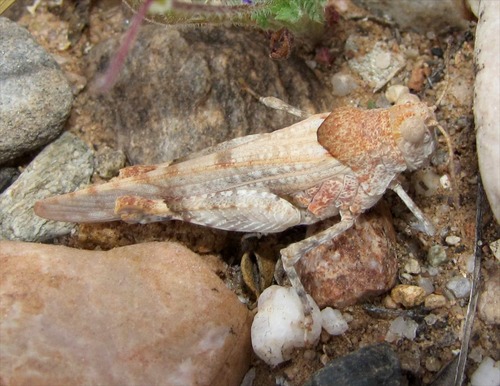
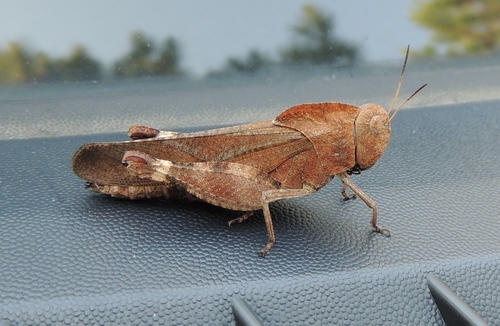
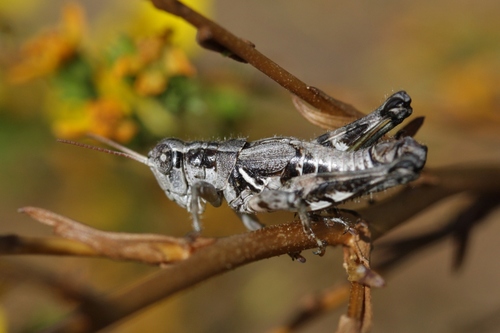
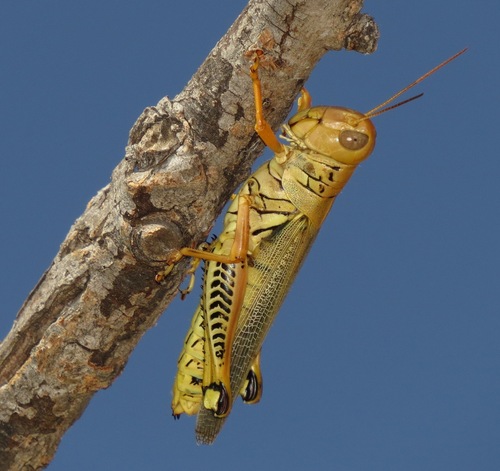
Description: Adult male Melanoplus differentialis reach a length of 28–37 mm, while adult females reach 34–50 mm. Their bodies are brownish or greenish, and their color darkens as they age. Some nymphs of the species can be bright yellow. Black grooves appear on the insect's pronotum. Males have boot-shaped appendages at the tip of their abdomen. Inverted chevron markings run along the hind femur, and the hind portion of the tibia is yellowish with black spikes. All adult individuals have yellow tarsi, and their antennae are either yellow or reddish-yellow.
Range and habitat: The differential grasshopper occurs across most of the United States, with the exception of the country's northwest. Within its distribution, it is most commonly found in dense weedy areas, grasslands, and also occupies vacant lots and other urban habitats. This species is not migratory, but it can travel distances of a few miles to forage for food. In the northern section of its range, M. differentialis occurs in roughly equal numbers to the two-striped grasshopper (Melanoplus bivittatus), while it is far more abundant than the two-striped grasshopper in the southern part of its range.
Life cycle: This species produces one new generation each year. An adult female can lay up to six egg masses in soft soil, with each mass holding between 40 and 200 eggs. Embryonic development begins in the eggs the summer they are laid, after which the eggs enter diapause to overwinter. They hatch over a roughly two-week period in early summer of the following year. After hatching, nymphs require approximately 32 days to reach full adulthood. Their development is highly synchronized, with most nymphs molting into winged adults within just a few days of each other. Differential grasshoppers are polyphagous, feeding on both grasses and forbs, though experimental data shows they grow faster when fed forbs. Their most preferred host plants are giant ragweed (Ambrosia trifida), common sunflower (Helianthus annuus), and prickly lettuce (Lactuca serriola). Adults can detect chemical changes in wilted lettuce and sunflower plants, and generally avoid feeding on these wilted plants.