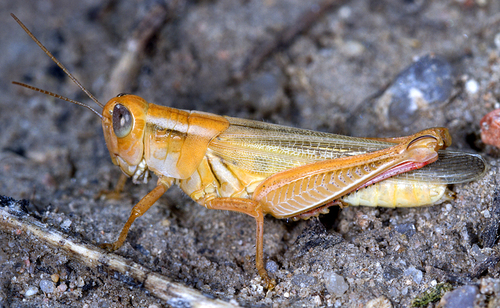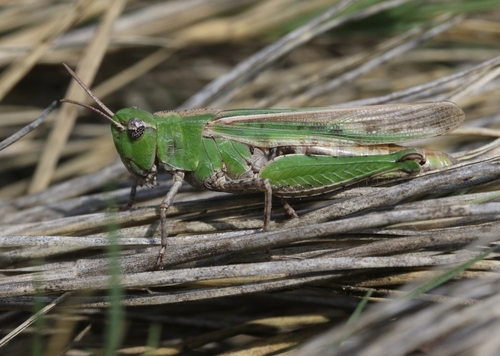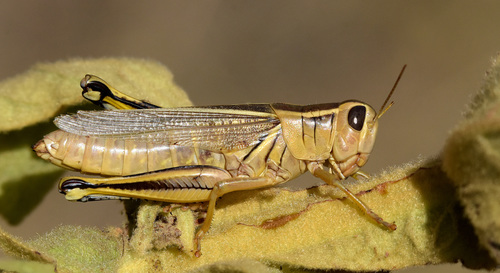
About Melanoplus bivittatus (Say, 1825)
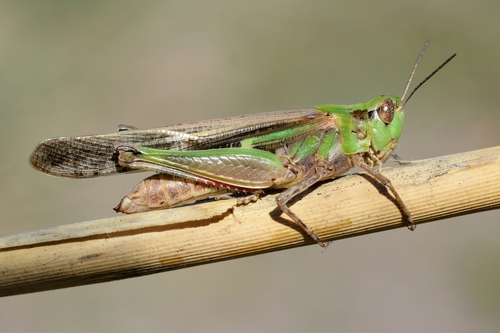
Identification: Melanoplus bivittatus is a relatively large grasshopper species, with individuals ranging from 30 to 55 mm in size. A pair of pale yellow stripes runs along the top of its body from above the eyes to the hind tip of the wings, which gives the species its common names: two-striped grasshopper or yellow-striped grasshopper. The whole body of this species is often yellowish green, a coloration produced by chromoprotein and carotenoids. The rest of its body structure resembles that of most grasshopper species: it has enlarged hind legs adapted for jumping and two pairs of overlapping wings. Life cycle: Eggs are laid in soil over the winter and hatch between late April and early May. Under optimal conditions of 25 °C and very high moisture, Melanoplus bivittatus eggs stop developing after approximately 21 days. Once development halts, the eggs enter diapause, and development resumes the following spring. When temperatures become warm enough, eggs begin hatching, with the maximum hatching rate occurring between the 10th and 13th day of this period. Nymphs pass through five instar stages as they develop into mature adults. Mating and reproduction: Melanoplus bivittatus engages in very long mating sessions, with some copulation events lasting up to 10 hours. The mating rituals of M. bivittatus are similar to those of red-legged grasshoppers (Melanoplus femurrubrum): both species exchange and receive nuptial gifts in the form of spermatophores. Spermatophores are provided throughout the entire copulation period, a process dominated by male activity. Long copulation periods support efficient transfer of sperm and nutrients to females. After mating with a male, females usually become receptive to remating within four days, but may wait up to 21 days to remate. Females generally do not reject males, because they gain protein and fitness benefits from consuming the spermatophore.