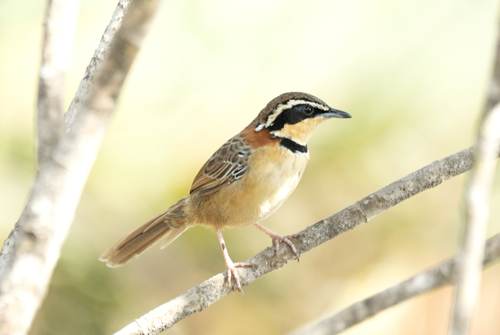
About Melanopareia torquata (Wied-Neuwied, 1831)
Species Naming & Body Length
The collared crescentchest (scientific name Melanopareia torquata) is 14.5 cm (5.7 in) long.
Specimen Weight
Two unsexed specimens of the subspecies M. t. rufescens weighed 16.5 g and 18.0 g (0.58 oz and 0.63 oz) respectively.
Nominate Subspecies Plumage
The nominate subspecies has brown back and rump, buff underparts, and a gray-brown crown. It has a narrow white supercilium edged with black, a rufous "collar" on the back of the neck, and a black band across the breast.
M. t. rufescens Plumage Difference
Subspecies M. t. rufescens is almost identical to the nominate subspecies, differing only by having a reddish brown crown.
Singing Behavior
Both sexes of the collared crescentchest sing year round, usually from the top of a low shrub.
Vocalizations
Its song is a series of 3-6 loud, resonant "chip" notes, and its call is a penetrating churr.
Geographic Distribution
The collared crescentchest is found primarily in central Brazil, and also occurs in far northeastern Paraguay.
Habitat Type
It inhabits cerrado, a biome characterized by a mix of savannah and woodlands.
Habitat Preferences
It prefers wetter open areas and avoids disturbed areas.
Elevation Range
Its elevation range extends up to 1,400 m (4,600 ft).