About Melanoleuca melaleuca (Pers.) Murrill
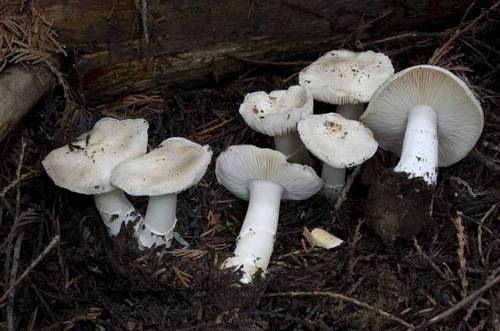
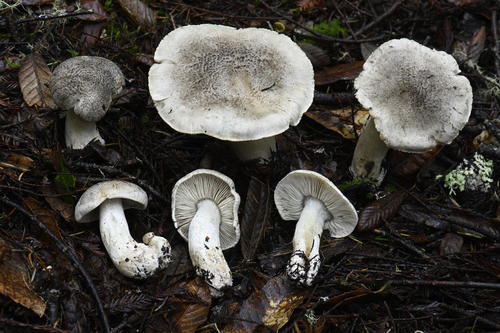
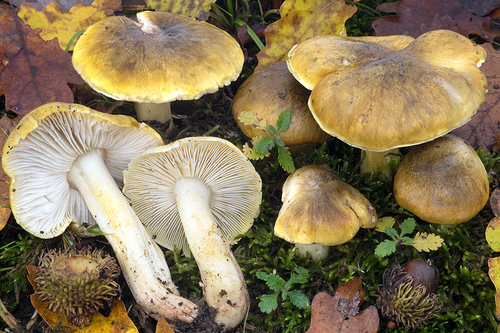
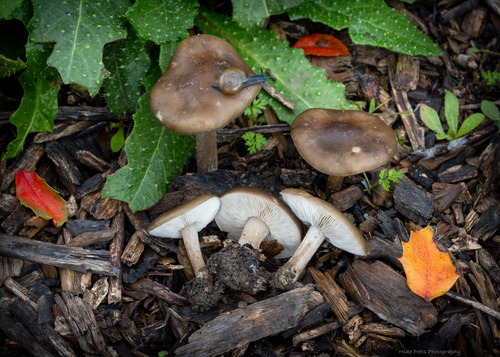
The scientific name of this species is Melanoleuca melaleuca (Pers.) Murrill. Its cap is 2–8 centimetres (3⁄4–3+1⁄4 inches) wide, low convex, often with a low umbo, and has a smooth texture. The cap is dark brown, fading to greyish brown. The gills are whitish, crowded, and usually attached emarginately to the stipe, though they can also be adnate to decurrent. Both the odor and taste of Melanoleuca melaleuca are mild. The stipe is 2–8 cm long and up to 1 cm thick. It shares a similar color to the cap, but is lighter, and marked with brown fibrils. The spores measure 6.5–8.5 x 5–6 μm, and are elliptical with amyloid warts, meaning they stain blue in Melzer's reagent. The spore print of this species is white. Cheilocystidia may be fusiform, or may be absent entirely. This is a widely distributed species, recorded from Asia, Africa, Europe, North America, and Oceania. It grows in grassy areas within woods, along roadsides, and in heathland. Like all species in the genus Melanoleuca, it is saprophytic, and feeds on organic litter. It is not associated with any specific types of tree.