About Melanohalea olivacea (L.) O.Blanco, A.Crespo, Divakar, Essl., D.Hawksw. & Lumbsch
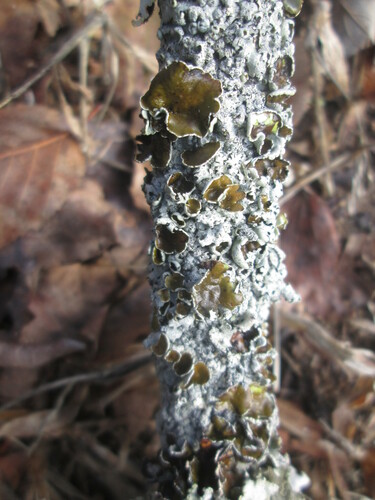
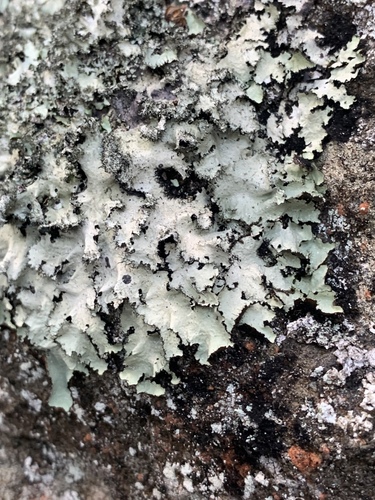
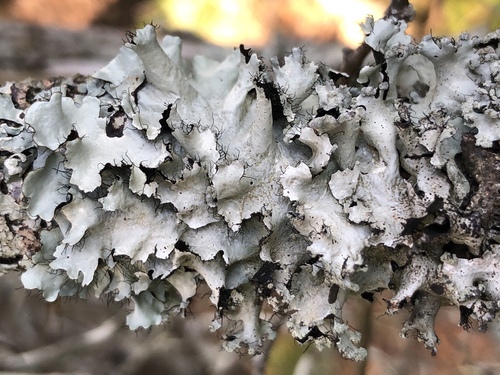
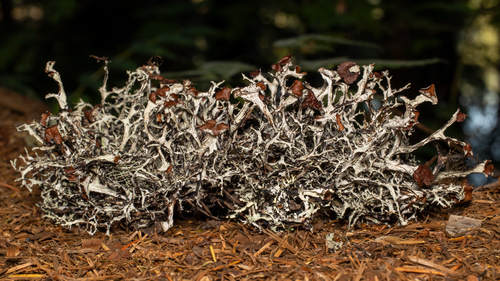
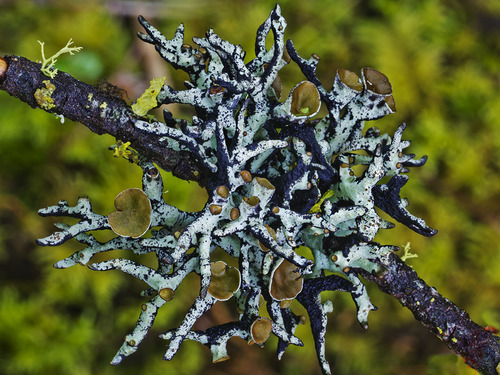
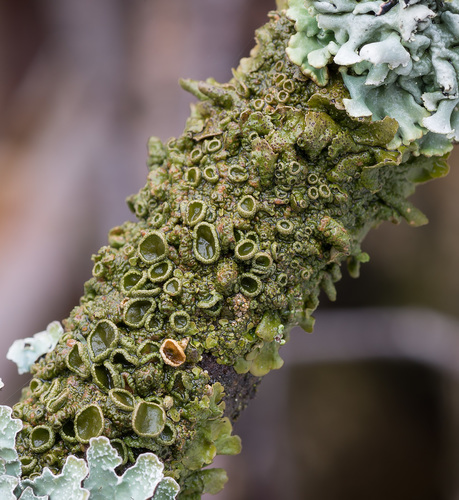
Melanohalea olivacea is a brown, foliose lichen that forms rounded rosettes. Rosettes are commonly 5–8 cm across, and may sometimes reach around 10 cm in diameter. The thallus (the main body of the lichen) is typically closely attached to its growing surface (the substrate), and is divided into fairly broad, leaf-like lobes that are usually 2–5 mm wide. Lobes can appear wavy or folded, especially towards the centre of older rosettes. Its upper surface ranges in colour from olive-green to dark brown; it is often dull in the central parts of the thallus, while outer lobes may look slightly shinier. This species typically lacks isidia and soredia, two common types of asexual propagules in lichens. Small, pale pseudocyphellae usually appear as small dot-like (punctiform) spots, mainly on the lobe surface, and are easiest to see near lobe margins. The lower surface of the thallus is typically black, with a narrow brown rim near the margins that does not have rhizines. The lower surface bears dense, dark rhizines that are mostly simple, and only occasionally sparsely branched. Apothecia (fruiting bodies for sexual reproduction) are common in mature thalli, and are usually concentrated towards the centre of the thallus rather than extending across the outer lobes. They are generally a few millimetres wide, with a dark brown disc and a raised margin. As apothecia age, their margin tends to become strongly crenulate and often pseudocyphellate. In cross-section, the spore-producing hymenium layer is hyaline (colourless), with a relatively thick subhymenium. Ascospores are hyaline, ovoid to ellipsoid, and typically around 12–17 × 7–11 μm, with some size variation. Pycnidia are often present as small dark points on the upper surface, and produce very small asexual spores called conidia. Chemical spot tests for this species typically give a PD+ (red) reaction, with negative K, C, and KC reactions. This result is consistent with the presence of fumarprotocetraric-type depsidones; the species often contains only traces of protocetraric acid, and atranorin is reported variably. Melanohalea olivacea is an epiphytic lichen, meaning it grows on plants, especially tree bark. It grows mainly on bark in cool, open, moderately humid habitats, particularly in boreal forests and montane birch woodlands. It is most often recorded growing on birch bark (Betula spp.), but also occurs on other broadleaved trees and shrubs such as alder (Alnus) and rowan (Sorbus), and only occasionally grows on dead wood or rock. In Fennoscandia, it is strongly associated with well-lit situations and can be especially abundant in mountain birch forests. In this habitat, it tends to avoid the lower parts of tree trunks that remain under snow for long periods. In northern Norway, the species preferentially occupies the upper, snow-free parts of birch trunks, unlike some other epiphytic lichens that remain buried under snow for much of the winter. In subarctic birch forests, M. olivacea often forms a conspicuous lower limit on tree trunks, commonly called the "olivacea line", which corresponds closely to the maximum depth of the winter snowpack. Below this level, prolonged snow cover and ice encapsulation reduce thallus vitality, whereas above it the species can dominate the bark surface and overgrow slower-growing epiphytes. The height of this boundary varies with habitat type and winter conditions, and has long been used as a natural indicator of late-winter snow depth in Scandinavian mountain birch woodlands. Recent field studies in subarctic mountain birch forests of northern Finland have quantitatively confirmed that Melanohalea olivacea is concentrated on trunk sections above the average annual snow cover, with a statistically strong relationship between its vertical occurrence and snow depth. In these forests, the species was recorded on all sampled trees and showed a strong association with snow-related variables, with abundance highest above the winter snowline and declining sharply below it. Because snow depth and winter temperature were among the strongest predictors of its occurrence, projected changes in snow cover and winter climate are expected to alter its local abundance and vertical distribution in subarctic birch forests. Studies of boreal forests have shown that epiphytic lichen communities are structured primarily by broad climate variables and the identity of the host tree species, rather than by the same environmental drivers that shape ground-layer lichens. At the south-western edge of its range in Switzerland, M. olivacea has been found on Betula in the birch belt around raised bogs in cold Jura valleys, typically growing alongside Melanohalea septentrionalis. In north-western China, regional treatments of Melanohalea from Xinjiang include M. olivacea among the species reported from the region. The species is essentially boreal, with an almost circumpolar distribution, and it tends to become less frequent southwards into the temperate zone. Biogeographically, Melanohalea olivacea is a boreal species with a circumpolar Holarctic distribution, extending farther south mainly in mountain regions. In a global sampling study, specimens identified as M. olivacea included material from both North America and Eurasia, consistent with its broad Holarctic distribution. Identical ITS haplotypes (matching DNA variants in the ITS barcode region) have been reported from western North America and eastern Asia, consistent with long-distance dispersal in this sexually reproducing, apotheciate species. The species has also been reported from Greenland in modern checklists, and included in DNA-barcode work on the region's brown Parmeliaceae aimed at improving identification for long-term monitoring. Although Melanohalea olivacea has been reported from the Caucasus region in regional catalogues, Sohrabi and colleagues suggested that most such records are probably misidentifications, chiefly confusion with Melanelixia glabra. They considered that recent collections from near the timberline (upper forest limit) in the Russian Caucasus are more likely to represent genuine occurrences of M. olivacea. Consistent with this uncertainty, the distribution maps in Ahti (1966) and Otte et al. (2005) did not show M. olivacea occurring in the Caucasus region. Within Europe, the species is common in Scandinavia but becomes scarce farther south, and it is very rare in Switzerland, where confirmed records are limited to a few localities in the Jura chain. The first comprehensive European checklist using revised genus concepts for parmelioid lichens placed the species under Melanohalea and provided a country-by-country account of its distribution based on reinterpreted records under the modern taxonomy. That checklist documented Melanohalea olivacea as occurring in several parts of northern and central Europe, while also noting that many earlier reports from other regions referred to different taxa, under a broader historical concept of olivacea. Subsequent updates to the checklist confirmed additional national records, including Norway and Switzerland, following further reassessment of material using the revised generic framework. The species is sensitive to prolonged ice encapsulation at mild subfreezing temperatures; increased winter icing events have been discussed as a potential risk to its vitality in boreal and subarctic regions. Across boreal birch forests, variation in epiphytic lichen composition has been shown to be influenced more strongly by factors on individual trees, especially height on the trunk, than by broader ecosystem-scale variables, a pattern that applies to M. olivacea and related species. Because epiphytic lichens respond to climatic gradients independently of ground-layer lichens, M. olivacea and similar canopy species are considered useful indicators of atmospheric and macroclimatic change in boreal forests.