About Melanohalea exasperatula (Nyl.) O.Blanco, A.Crespo, Divakar, Essl., D.Hawksw. & Lumbsch
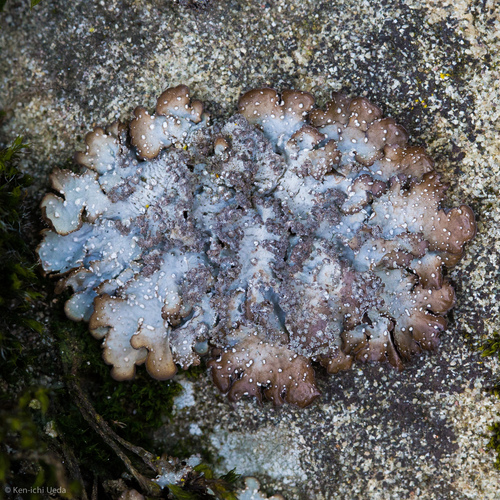
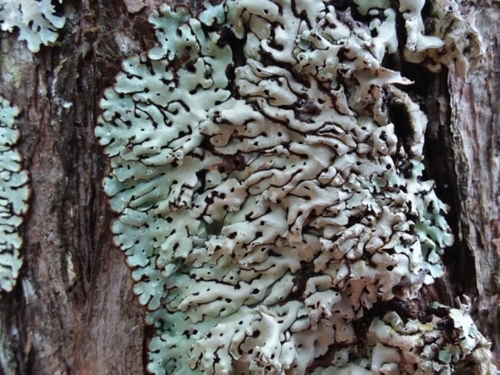
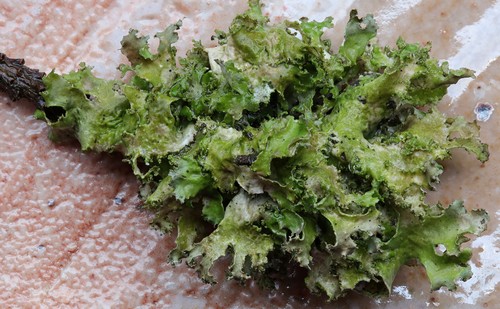
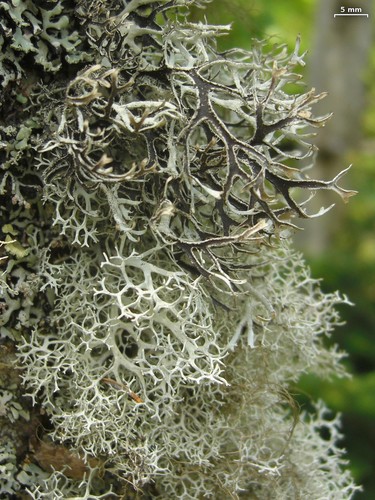
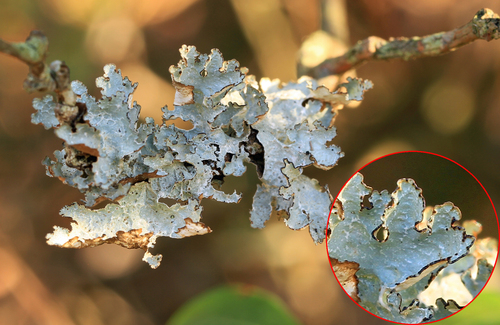
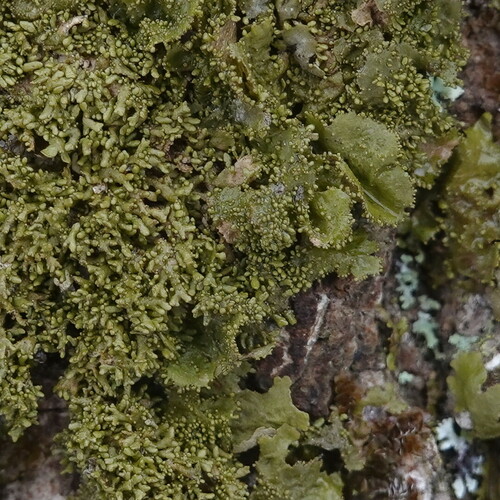
Melanohalea exasperatula is a foliose lichen whose main body (the thallus) can grow up to 5 cm (2 in) in diameter. The thallus is typically thin and closely flattened against its substrate in its central region. The leaf-like marginal lobes along the edge of the thallus reach up to 5 mm broad, are often wavy with irregularly notched edges, and are frequently raised at their margins. The shiny upper surface of the thallus ranges in colour from pale olive-green to dark olive-brown or red-brown, and becomes slightly transparent when wet. This species produces isidia, small surface outgrowths for reproduction; the isidia of Melanohalea exasperatula are unbranched, swollen, hollow, and often develop a club-shaped (clavate) or spoon-shaped (spathulate) form. Over time, they grow into divided small lobes (lobules), are usually decumbent (lie flat against the thallus), and oriented in all directions. Isidia are very dense toward the centre of the thallus: they start as roughly spherical structures when young, become flatter as they age, and reach up to 2 mm long, developing from small cylindrical rounded growths called papillae on the thallus surface. The lower surface of the thallus ranges from pale tan to pale brown, or may match the colour of the upper surface, while the central lower region is dark brown. The scattered, root-like attachment structures called rhizines are pale. Fruiting bodies known as apothecia are rare in this species, measuring 2–3 mm in diameter; their concave disc is pale red-brown, and they have an uneven, isidiate margin. The reproductive ascospores are ellipsoidal, and measure 8–10 by 3.5–8 μm. Structures that produce asexual spores, called pycnidia, are not produced by this species. Chemical testing via thin-layer chromatography detects no secondary lichen metabolites in Melanohalea exasperatula. Melanohalea exasperatula has a widespread global distribution, occurring in Africa, Asia, Europe, North America, Macaronesia, and Central America. It is widely distributed across Europe, where it has been recorded in 38 countries. In North America, its range extends north to Alaska and Arctic regions, covers the Great Lakes area, the Pacific Northwest, and the Rocky Mountains, and reaches south to the southwestern United States; it does not occur in Mexico. It is suspected to have a circumpolar distribution, though its presence in Asia is not well documented. The species most commonly grows on the trunks and branches of nutrient-rich broad-leaved trees, particularly sycamore (Acer pseudoplatanus). It can also grow on open hillsides, and occasionally occurs on rocks, walls, and wooden fence rails located under trees. It can also grow foliicolously (directly on leaves), where young lobules establish on spruce needles. In Greenland, it grows on the bark of dwarf shrubs, the wood of Picea, and on both siliceous and basaltic rocks, almost always in nutrient-enriched habitats. It is often found in relatively polluted areas and appears to be becoming more common in these environments, and is thought to have a high requirement for nitrogen or phosphate. Regional distribution patterns of M. exasperatula are shaped more by current environmental conditions than by the species' reproductive strategies. Along with Melanohalea elegantula, it is associated with eutrophication and air pollution, supporting the suggestion that it prefers environments with high nitrogen or phosphate levels. The species has strong dispersal ability, and is commonly found in nutrient-rich habitats including urban areas and sites with human-caused disturbance. Its intercontinental distribution indicates it is capable of effective long-distance dispersal. Together with M. elegantula, it has the potential for broad geographic spread, a trait that contrasts with other Melanohalea lineages that have much more restricted distributions. Two lichenicolous (lichen-dwelling) fungi have been recorded growing on this species: Crittendenia coppinsii, found on multiple collections of M. exasperatula in Europe, is thought to have an asexual yeast life cycle stage, as its DNA has been detected on completely asymptomatic M. exasperatula specimens. A second lichenicolous fungus, Stagonospora exasperatulae, parasitizes only M. exasperatula. Because M. exasperatula does not produce defensive secondary metabolites, it is highly susceptible to grazing by gastropods. Both laboratory and field experiments show that gastropods strongly prefer this lichen over species that produce chemical grazing deterrents. This preference means the absence of chemical defenses affects the species' distribution and abundance, leading to heavier grazing in undisturbed natural habitats. As a result of this grazing pressure, M. exasperatula is most often found in more sun-exposed areas that have lower gastropod activity, demonstrating the impact of herbivory on lichen community structure and ecological niches.