About Melanodera melanodera (Quoy & Gaimard, 1824)
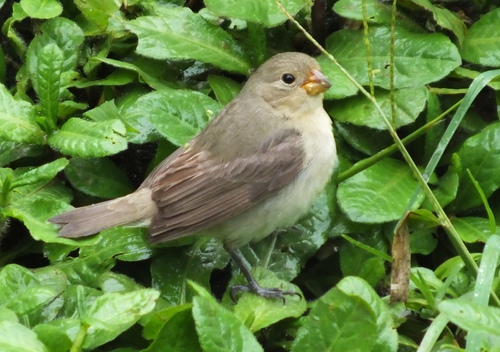
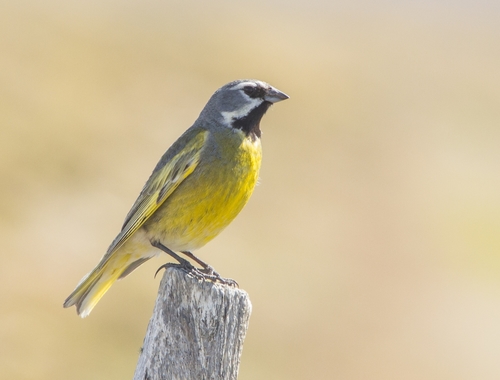
This species has the scientific name Melanodera melanodera (Quoy & Gaimard, 1824). Males are grey-green on the upper body, yellow on the lower body, with a grey head and upper breast. They have a black throat and black mask, both bordered with white, and large yellow patches in the wings and tail. Females are brown with dark streaks; they have yellow outer tail feathers and yellow fringes on their wing feathers. The species measures 14–15 cm (5.5–5.9 in) in total length. Mainland individuals are smaller than Falkland Islands individuals, with smaller bills and more yellow coloration in their wings and tails. The call is a short, high-pitched note, while the song is a repeated series of two or three whistles. The species sings from low perches such as rocks or grass tussocks. It is common across the Falkland Islands, where it occurs up to around 150 m (490 ft) above sea level, and is most often found in coastal areas. On the South American mainland, it has a thin distribution in Chile's Magallanes Region and Argentina's Santa Cruz Province, occurring up to 580 m (1,900 ft) above sea level. Its range extends south from roughly 47°S to northern Tierra del Fuego. It typically inhabits flat areas of grassland, heathland, farmland, or dunes. The Falkland Islands population numbers around 7,000 to 14,000 pairs, and the species is not considered threatened. However, the mainland population is thought to be declining due to overgrazing.