About Melanitta perspicillata (Linnaeus, 1758)
Surf scoters (Melanitta perspicillata) reach sexual maturity at 3 years of age. On average, adult males weigh 1,050 g (2.31 lb) and measure 48 cm (19 in) in length, while adult females average about 900 g (2.0 lb) and 44 cm (17 in) in length, making this the smallest average scoter species. This species has a wingspan ranging from 29.9–30.3 in (76–77 cm).
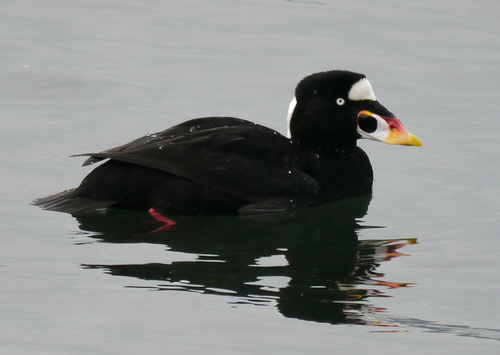
Adult males have entirely velvety black plumage, with the only exceptions being white patches on the forehead and nape. They have a swollen bill that appears orange from a distance, but is actually patterned with white, red, and yellow, with a black spot near the base. Adult females are browner than males, with fairly uniform plumage that is slightly darker on the upper body than the lower. They have indistinct paler patches on the cheeks below the eye, and sometimes a whitish patch on the nape – this is a unique trait among scoters. Female bills are black with green or blue coloration.
Juveniles have plumage similar to that of adult females, but are overall paler and browner, with whitish breast and belly. The adult male’s white head patch and unique bill pattern easily distinguish the surf scoter from other scoter species. Compared to other scoters, female and immature surf scoters have a bulkier bill with a squarish base and a more flattened head profile. While the black scoter and white-winged scoter are physically very similar to the surf scoter, surf scoters are the only of these species to have completely dark wings in flight.
Like all sea ducks, surf scoters become flightless during the simultaneous molt of their flight feathers. This vulnerable period usually occurs from late July through early August, and lasts around four weeks. This wing molt begins a complete body (prebasic) molt that is completed in the fall, producing the next basic (breeding) plumage. Before the prebasic molt, many duck species undergo a partial prealternate molt that replaces the bright basic plumage of breeding males with a duller alternate (eclipse) plumage. For surf scoters, the prealternate molt is believed to be limited or absent, so males look similar in both basic and alternate plumage, though they may have a browner belly and a duller or "messier" appearance in summer. Plumage is a reliable indicator of age for male surf scoters, but not for females. Second-year males are similar to full adults, but may have brownish feathers and/or lack the white forehead patch.
Compared to most North American sea ducks, the surf scoter breeds exclusively in North America, mostly in northern Canada and Alaska. After breeding, they take different migration routes to spend the winter in more temperate environments. While small numbers regularly winter as far south as the British Isles in western Europe, the vast majority of surf scoters winter along the Pacific and Atlantic coasts of North America. The Pacific coast hosts the highest number of individuals, with a large wintering range that extends over 5,000 km (3,100 mi) from the Aleutian Islands in Alaska to the Baja Peninsula in Mexico.
This migratory species breeds in boreal forests near northern freshwater lakes. Very few nests have been observed, but those found tend to be located near spruce cover, on slightly upland ground adjacent to wetland areas. To complete their molt before migration, surf scoters travel to dedicated molting sites that are separate from their wintering and nesting sites. Because the ducks are in a vulnerable state during this period, molting sites are thought to provide abundant food and lower predation risk, and they are located in bays, inlets, or estuaries. Surf scoters winter in nearshore marine habitats.