About Melanitta americana (Swainson, 1832)
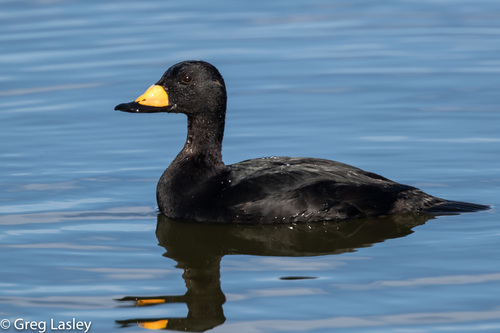
Melanitta americana, commonly called the black scoter, is a large sea duck defined by its bulky shape and large bill. Adult males are entirely black, with a very bulbous, mostly yellow bill. Females are brown with pale cheeks, and look very similar to female common scoters. On average, adult females weigh around 980 g (2.16 lb) and measure 45 cm (18 in) in length, while adult males average 1,100 g (2.4 lb) and 49 cm (19 in) in length. This species can be told apart from all other scoters except the common scoter by the complete lack of white markings on adult males, and more extensive pale areas on females. The black scoter breeds in the far north of North America, ranging from Labrador and Newfoundland to the southeast and northwest of Hudson Bay. It also breeds on the Siberian side of the Bering Straits, east of the Yana River. It winters further south in temperate zones, along the coasts of the northern United States and Canada: on the Pacific coast it ranges south to the San Francisco Bay region, on the Atlantic and Gulf of Mexico coasts, and in Asia it reaches as far south as China. A small number of black scoters may over-winter on the Great Lakes. This species is a very rare vagrant to western Europe; only males can be reliably identified outside of their normal range, so out-of-range females are likely to go undetected. During migration and winter on coasts, this species dives to feed on crustaceans and molluscs. When nesting on freshwater, it feeds on insects and their larvae, especially caddisflies, fish eggs, and more rarely on vegetation such as duckweed. In winter, black scoters form large, tightly packed flocks on suitable coastal waters, and the birds typically take off together. They are less social during the breeding season. Research suggests that in coastal waters, this species prefers sheltered embayments and possibly waters with a mix of different depths. Black scoters nest later than most other duck species in North America. Pairs form in late winter or spring. The lined nest is built on the ground close to the sea, lakes or rivers, in woodland or tundra habitat. Females lay 5 to 7 eggs, each weighing 60 to 74 g (2.1 to 2.6 oz), which equals roughly 8% of the female's body weight. Incubation lasts between 27 and 31 days. Females brood their young extensively for around 3 weeks, after which the still flightless young must fend for themselves. When stretching his wings, the male black scoter performs a distinct downward head movement.