About Melanitis zitenius Herbst, 1796
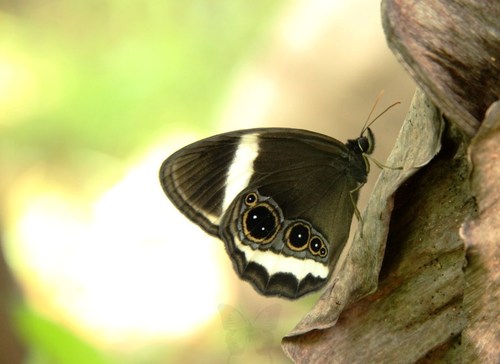
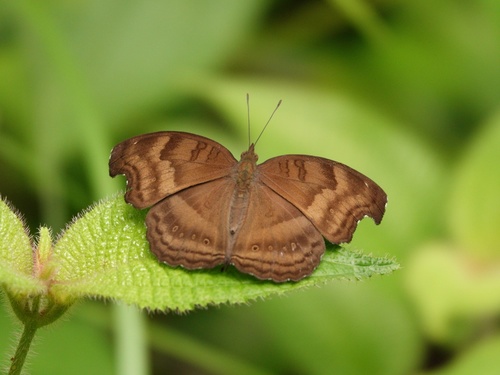
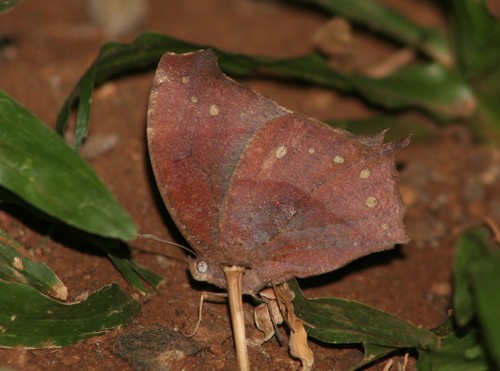
Melanitis zitenius (described by Herbst in 1796) has two distinct forms: the wet-season form and dry-season form. In the wet-season form, found in both males and females, the forewing has a strongly arched costa and an acute apex. Immediately below the apex, the termen is angulate in males and falcate (sickle-shaped) in females. The upperside is similar in appearance to that of Melanitis ismene, but its overall ground color is a somewhat warmer brown. It has a very broad ochraceous yellow patch located above and beyond the subapical black spots, and this patch is larger in females than in males. The underside is closely sprinkled (irrorated) with dark brown lines (striae); the ocelli here are subequal, and are much smaller and less clearly defined than the ocelli of M. ismene. In the dry-season form, the forewing costa is less strongly arched, and the apex is very falcate in both sexes. Compared to the wet-season form, the dry-season form has a greater amount of ochraceous yellow on the forewing apex. This yellow pigment forms a very broad band that runs from the costa above and beyond the subapical black spots, spreads downward, and encircles the spots, except for a narrow band that connects the spots to a large black mark beyond the apex of the cell. The hindwing of the dry-season form has two or three white posterior subterminal spots. The underside is similar to that of M. ismene but is less variable, and its ocelli are often entirely obsolete. The known food plants for this species include Bambusa arundinacea.