About Melanelia stygia (L.) Essl.
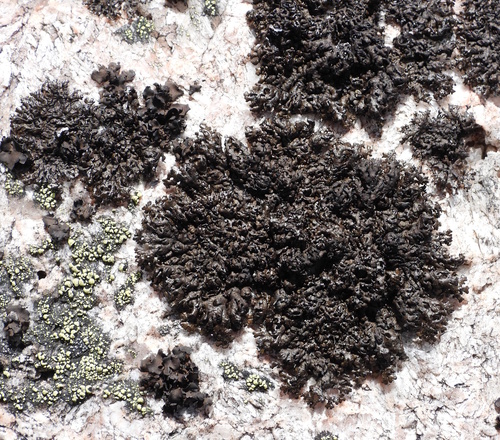
Melanelia stygia (L.) Essl. forms dark, leafy lichen growths 2–6 cm across, and occasionally reach up to 8 cm. The lichen body, called a thallus, attaches somewhat loosely to its substrate and has a fleshy texture. Its lobes are relatively narrow, measuring 0.5–2 mm wide, rarely reaching 3 mm. These lobes are thick, and can be flat, convex, or almost cylindrical (terete) in cross-section. They grow outward in an irregular branching pattern, and often overlap and intertwine with each other to create a complex structure. The species can reach large sizes, with the largest documented thalli measuring up to 12 cm in diameter, though such large specimens are rare. Studies from Norwegian glacier forelands found that average mature specimens typically reach around 62 mm in diameter. The upper surface of the thallus is dark brown to nearly black with a glossy sheen. Under magnification, tiny dark brown dots called pseudocyphellae can be seen scattered across the surface, each surrounded by a slightly raised rim. The lower surface shares a similar dark colour and has a wrinkled texture, anchored by thick, mostly unbranched root-like structures called rhizines. Melanelia stygia regularly produces disc-like reproductive structures called apothecia, which can grow up to 5 mm in diameter. Young apothecia start concave, but flatten or become convex as they mature, and stay dark brown and glossy. Their edges are notably warty and irregular, and bear the same tiny pseudocyphellae found on the main thallus. This lichen does not produce soredia or isidia, alternative reproductive structures common in many other lichen species. The apothecia are constricted at their base, and contain microscopic spore-producing structures inside. The species also commonly produces pycnidia that are embedded within the lobes, which release dumbbell-shaped conidia measuring 3.5–5.5 μm in length. When tested with chemical reagents commonly used for lichen identification, the outer layer of the thallus turns brown in potassium hydroxide (K), while tests with calcium hypochlorite (C) and the combined KC test show no reaction. The inner layer, called the medulla, typically shows an orange-red reaction when tested with para-phenylenediamine (Pd), caused by the presence of fumarprotocetraric acid. However, some specimens show no reaction to any of these chemicals, and contain either caperatic acid or no detectable lichen substances at all. A chemical-profiling study of Icelandic herbarium material detected no major lichen products in M. stygia under its LC-MS testing conditions. The authors noted geographic variation in chemical reports: depsidones such as fumarprotocetraric and protocetraric acids have been reported from Chinese collections, while some European material has been reported to lack any major lichen substances. Melanelia stygia is a slow-growing species. Documented annual diameter increases are only 0.5 mm per year even under optimal conditions. Its growth pattern is defined by relatively rapid early growth, followed by a gradual decrease in growth rate over time. This growth rate is notably slower than most other parmelioid lichens, which is likely an adaptation to the harsh conditions of its alpine and arctic habitats, where the growing season is limited by persistent snow cover and low temperatures. Melanelia stygia has a circumpolar distribution, occurring throughout arctic and alpine regions in both continental and oceanic areas. The species has a notable altitudinal range, and has been recorded at elevations up to 3,000 metres in the Caucasus Mountains. It is widely distributed in Europe, and has been recorded from 23 countries across the continent. It is most abundant in northern North America, particularly in Canada's coastal provinces and the Subarctic regions further north. This lichen is most commonly found on non-calcareous, particularly siliceous rocks, and occurs in a range of environments from arctic tundra to high mountain vegetation zones. In Central Europe, it is most often found in open areas of the upper mountain belt, particularly in plant and lichen communities characterised by the presence of rock tripe lichens, called the Umbilicarion cylindricae community. While it typically colonises rock surfaces, the species has also been recorded growing on bare soil and decomposing plant material. In the British Isles, as in other parts of its range, M. stygia prefers exposed rocky habitats at higher elevations. Its ability to grow in both extremely cold arctic environments and high-altitude alpine regions shows it tolerates harsh climatic conditions. However, this adaptation to extreme environments may make it vulnerable to climate change. Like other species restricted to open habitats in boreal, alpine and Arctic zones, M. stygia is predicted to respond negatively to warming temperatures and associated vegetation changes, though its specific responses to these environmental shifts remain largely unknown. While the species has remarkable tolerance for harsh climatic conditions, its growth is significantly constrained by environmental factors. Even so, in its alpine habitats it may benefit from increased moisture availability from frequent rain, mist and fog, which allows for extended periods of metabolic activity when conditions are suitable. Melanelia stygia can be used as a dye for wool, producing a colour that ranges from tan to brown.