About Melanelia hepatizon (Ach.) A.Thell
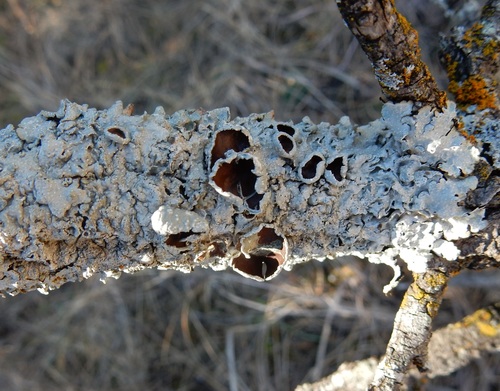
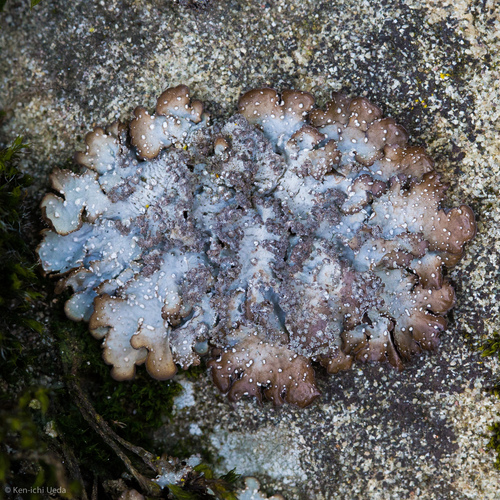
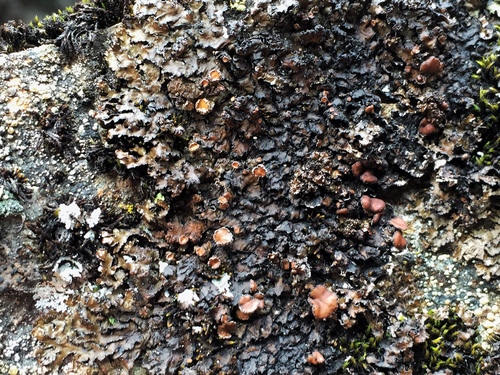
Melanelia hepatizon (Ach.) A.Thell has a dark brown, often shiny thallus that is usually closely appressed to its substrate. The thallus grows up to 3 cm in diameter, and is made up of narrow lobes that are most often 0.4–1.5 mm wide, occasionally reaching 2.5 mm in width. The lobe edges are distinctly thickened. This species does not produce either soredia or isidia. A key identifying trait of Melanelia hepatizon is the presence of prominent white pseudocyphellae (pores that allow gas exchange) along lobe margins, particularly around the edges of apothecia, the species’ sexual fruiting bodies. The lower surface of the thallus is black at the center, and shifts to dark brown towards the edges. Rhizines are sparse and found mainly along the lobe margins. The asexual fruiting bodies, called pycnidia, are black, cylindrical structures that are usually easily visible on or near lobe margins. Apothecia are common for this species; they have a lecanorine form, with a red-brown to brown disc that can grow up to 5 mm in diameter. The conidia of this lichen are dumbbell-shaped, and measure 4 to 6 micrometers in length. Melanelia hepatizon is a circumpolar species with a wide range of ecological tolerance, growing in many different environments, from arctic sites at sea level to alpine belts in lower latitude regions, and from oceanic to continental locations. It has been recorded growing at elevations of 3,600 m (11,800 ft) and 4,500 m (14,800 ft) in the Himalayas. This lichen grows primarily on siliceous rocks, and occasionally grows on wood or mosses. It occurs in various lowland and mountain tundra communities, as well as in open, exposed alpine vegetation. Documented distribution includes China, Iceland, Greenland, and it is widespread across Europe, with records from 23 European countries. It is also widely distributed across the Russian Arctic. In North America, its range covers the Pacific Northwest and the Rocky Mountains extending north to Alaska and other western arctic regions, plus the Appalachians and Great Lakes regions in the east. It is most often found in sun-exposed habitats within boreal, alpine, and Arctic zones. Because it prefers cool, stable environments, Melanelia hepatizon is predicted to respond negatively to climate change: as temperatures increase and habitats shift, this species may experience declines in both abundance and distribution.