About Melanchra persicariae Linnaeus, 1761
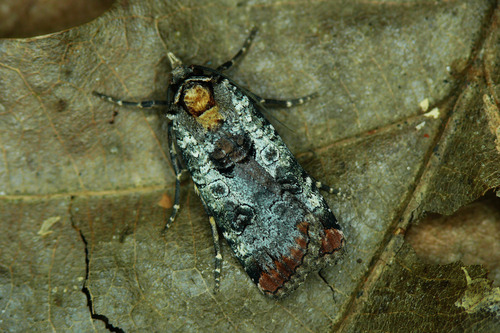
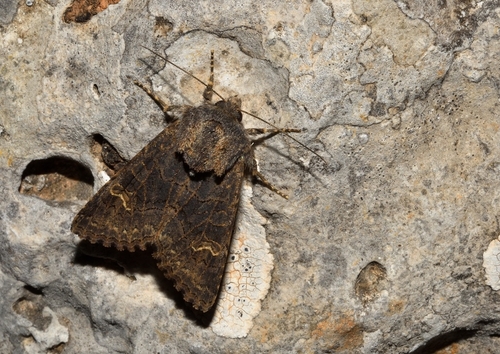
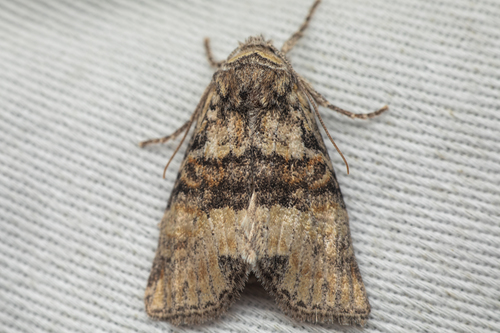
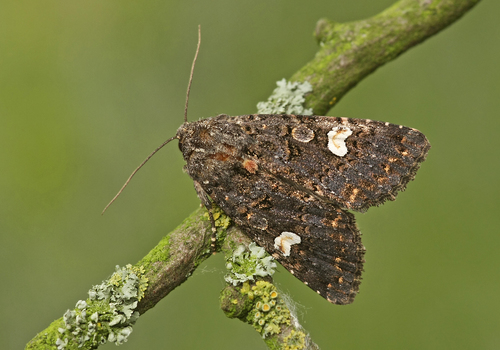
Melanchra persicariae was first described by Linnaeus in 1761. For the typical form, the forewing is purplish black, with lines and stigma edges that are even blacker. The reniform stigma has a rufous center surrounded by a cream white filling. The yellowish white submarginal line is broken into spots, which are preceded by black wedge-shaped marks. The hindwing is dirty whitish, with a broad blackish terminal border; the veins and cellspot are blackish, and the fringe is paler. The aberration accipitrina Esp. has a dark reniform stigma with only a slight paler external border. This aberration is common in Europe but does not occur in Britain, and has not been observed from Japan, though Oberthur recorded it from Askold Island. Additional information can be found in Hacker et al. The larva of Melanchra persicariae is rather variable in colour, and may be green, brown, purplish, or pinkish. It has a pale dorsal line, and a series of thick green V-shaped marks on the dorsum; the marks on segments 4, 5, and 11 are broader, and the 11th segment is humped. It also has diagonal markings that are lighter than the base body colour. The larva is polyphagous, feeding on a wide variety of plants; a full list of recorded food plants is documented in Robinson, G. S. et al. This species overwinters in the pupal stage. The distribution of Melanchra persicariae extends from Spain in the west to Korea and Japan in the east. It is found across most of Europe, excluding south-eastern Europe. To the north, its range includes Scotland and southern Fennoscandia; eastward, it extends through southern Russia, the Russian Far East, Siberia, and Central Asia to the Kamchatka Peninsula, and continues through northern China to Korea and Japan. Its southern range boundary runs through northern Spain, Italy (excluding Sicily), Macedonia, Bulgaria, Asia Minor, the southern Caucasus, and northern Iran. In the Alps, this species occurs up to approximately 1000 m. Melanchra persicariae occupies a wide range of habitats, including woodland, field and meadow edges, hedgerows, and gardens.