About Melanargia galathea Linnaeus, 1758
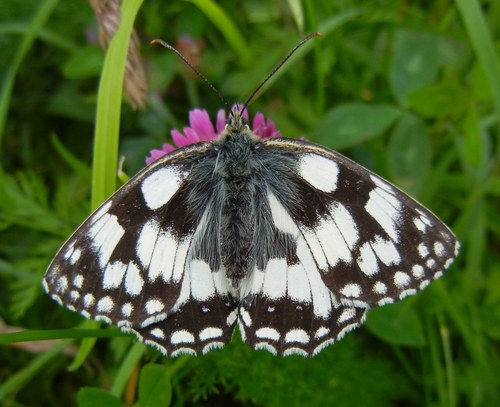
Melanargia galathea, commonly known as the marbled white, is a medium-sized butterfly with a wingspan of 46–56 millimetres (1.8–2.2 in). The upper side of its wings is marked with white, gray-black, and dark brown patterns; the basal and distal areas are always checkered with gray-black or dark brown. The underside of the wings has a similar pattern to the upper side, but the markings are light gray or light brown. A row of gray eye spots is present on the underside of the hindwings. Males and females are quite similar, though some females may have a yellowish tint on the underside of the wings. As described by Seitz, an undivided oval white spot sits in the otherwise black cell of both wings. On the upper side of the hindwing, the ocelli are either completely invisible or only show through very faintly from the underside. This species is quite similar to the Iberian marbled white (Melanargia lachesis), which replaces M. galathea in Spain and southern France. Fully grown caterpillars of M. galathea reach about 28 millimeters in length. They are green or yellow with narrow longitudinal lighter and darker stripes, and always have a light brown head. Newly hatched larvae are lime-green with a dark green line running down the middle of their back. This species can be found across most of Europe, southern Russia, Asia Minor, and Iran, with an isolated population located in Japan. It is not present in Ireland, northern Britain, most of Scandinavia (only excluding Denmark), Portugal, or Spain. Its range expanded in the United Kingdom during the late twentieth century. It inhabits forest clearings and edges, meadows, and steppe, occurring up to 1,500–1,700 m above sea level. It is common in unimproved grasslands across southern Britain, particularly on the South Downs, and extends slightly further north to sites including Dunstable Downs, Devil's Dyke near Newmarket, Fleam Dyke, Les King Wood near the South Cambridgeshire village of Cottenham, the "Edwards" wood, and Dry Drayton. Like other members of its subfamily, M. galathea larvae feed on various grasses, including Phleum pratense, Poa annua, Poa trivalis, Festuca rubra, Bromus erectus, Dactylis species, Brachypodium pinnatum, Agrostis capillaris, Elymus (synonymized as Elytrigia) species, Holcus species, Triticum species, and Agropyron species. Females lay eggs either while on the wing, or from brief perches on grass stems, simply sprinkling the eggs among the grass stems. When larvae hatch, they immediately enter hibernation, and only begin feeding the following spring once fresh grass growth appears. Pupation occurs at ground level inside a loose cocoon. Adult butterflies are active from early June to early September. In suitable habitats during warm, sunny weather, thousands of individuals can be seen fluttering gently among grass heads.