About Melaleuca viridiflora Sol. ex Gaertn.
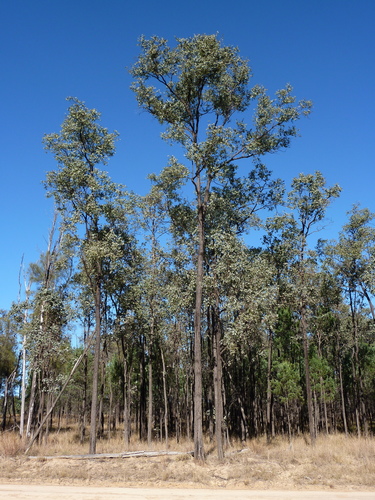
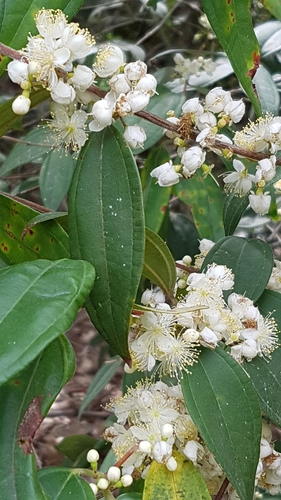
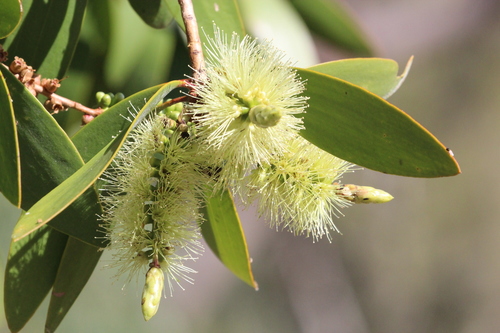
Melaleuca viridiflora Sol. ex Gaertn. is a shrub or small tree that usually grows to 10 metres (30 feet) tall, and may sometimes reach twice that height. It has white, brownish or grey bark and an open canopy. Its leaves are thick, broadly elliptic, aromatic, and measure 70–195 mm (3–8 in) long and 19–76 mm (0.7–3 in) wide.
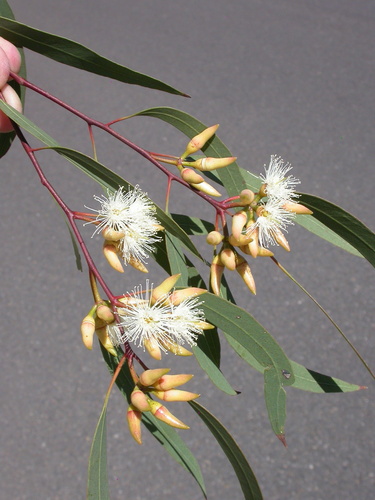
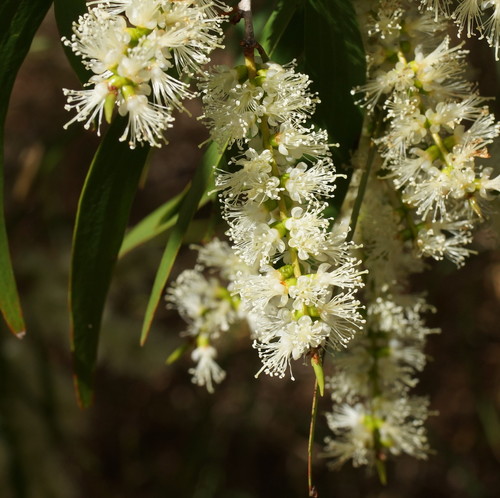
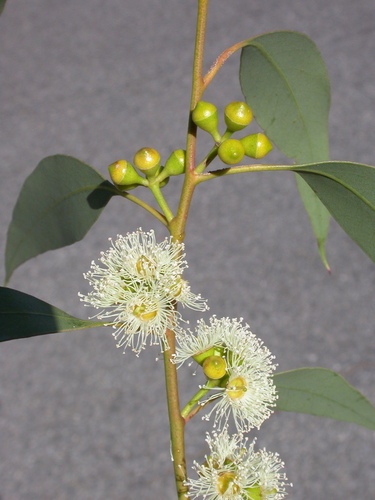
The flowers of this species are cream, yellow, yellow-green, or occasionally red. They are arranged in spikes at the ends of branches that continue growing after flowering, and sometimes also appear in upper leaf axils. Each spike holds 8 to 25 groups of three flowers each, and grows up to 100 mm (4 in) long and 55 mm (2 in) in diameter. The petals are 4–5.3 mm (0.16–0.21 in) long and fall off as the flower matures. Five bundles of stamens surround each flower, with 6 or 9 stamens per bundle, though the stamens are only weakly joined into these bundles. Flowering can occur at any time of year but is most common in winter.
After flowering, the plant produces woody capsule fruits 5–6 mm (0.20–0.24 in) long, scattered along the stem. Each capsule contains numerous fine seeds.
This melaleuca grows in tropical regions, occurring in Australia as far south as Maryborough in Queensland, across northern Western Australia south to the Dampier Peninsula district, and throughout the northern half of the Northern Territory. It is also found in southern West Papua (Indonesia) and southern Papua New Guinea. It grows on gallery forest margins, in forest, woodland and swampy plains, and tolerates a variety of soils.
Forests of Melaleuca viridiflora provide habitat for a number of orchid species, including the rare, threatened or endangered Calochilus psednus, Pachystoma pubescens, Eulophia bicallosa, and the Cardwell midge orchid (Genoplesium tectum). Individual trees often host the epiphytic ant-house plant Myrmecodia beccarii. Plants distributed in south-eastern Florida in 1900 under the name Melaleuca viridiflora were later reidentified as Melaleuca quinquenervia.
Aboriginal Australians use Melaleuca viridiflora for multiple traditional purposes. Its bark is peeled off in layers and used to make shelter, bedding, containers, for storing and cooking food, as fire tinder, to construct watercraft and fish traps, and for wrapping corpses. In traditional medicine, a leaf infusion is drunk, inhaled, or used in bathing to treat coughs, colds, congestion, headache, fever and influenza.