About Melaleuca thymoides Labill.
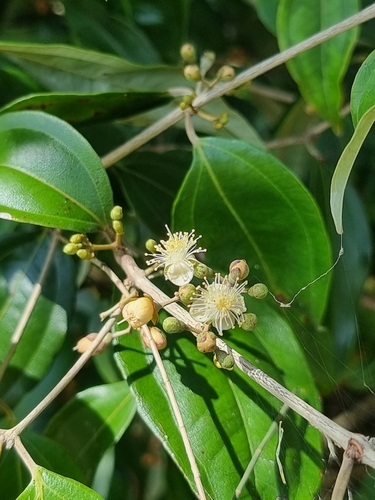
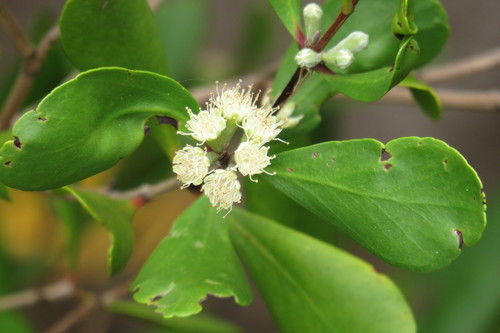
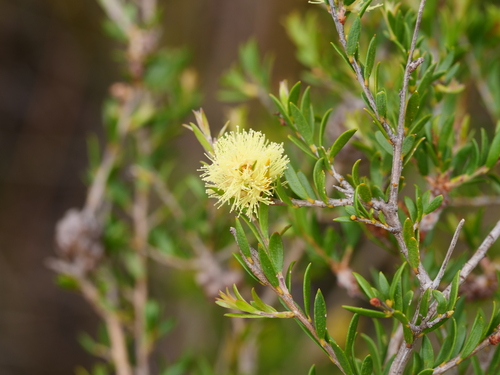
Melaleuca thymoides Labill. is a spreading shrub. It is usually no more than 1 metre (3 feet) tall and wide, though it can sometimes reach 3 metres (10 feet) in height. Its branchlets usually end in a sharp spine. Its leaves are arranged alternately along the stem, between 2.4 and 13.8 millimetres (0.09 to 0.5 inches) long and 0.7 to 3.6 millimetres (0.03 to 0.1 inches) wide. The leaves are lance-shaped to narrow oval, end in a sharp point, and have one central vein plus two marginal veins. The bright yellow flowers are arranged in a spike or head near the ends of branches. These flower heads can be up to 15 millimetres (0.6 inches) in diameter, and hold 2 to 15 groups of three flowers each. The stamens are arranged in five bundles around each flower, with between 7 and 11 stamens per bundle. Flowering occurs from August to February, with peak flowering in October and November. After flowering, the plant produces woody capsule fruits. The capsules are 2.3 to 4 millimetres (0.09 to 0.2 inches) long, and grow in clusters of around six that measure roughly 10 millimetres (0.4 inches) in diameter. The rim of each fruit capsule is flat. This melaleuca occurs in coastal areas between and within the Perth, Albany, and Cape Arid districts, across the Avon Wheatbelt, Esperance Plains, Jarrah Forest, Mallee, Swan Coastal Plain, and Warren biogeographic regions. It grows in sand on granite hills, and in areas that flood after rain.