About Melaleuca thymifolia Sm.
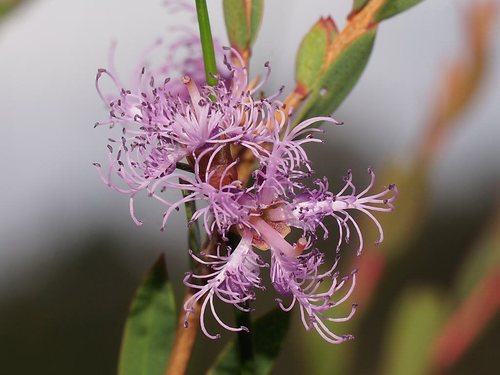
Melaleuca thymifolia Sm. is a low, spreading shrub that reaches a height of around 1.0–1.5 m (3–5 ft). It has grey corky bark, glabrous foliage, and arching branches. Its leaves are arranged in decussate alternating pairs, forming four rows along the stem. The leaves are 5–15 mm (0.2–0.6 in) long and 1.0–3.5 mm (0.04–0.1 in) wide, flat, elliptical with a tapered end, and their upper surface is often held almost parallel to the stem. The flowers range in color from pink to deep purple, and arranged in heads. These heads grow either at the ends of branches that continue growing after flowering, or on the sides of branches. Each head holds 2 to 10 individual flowers and reaches up to 25 mm (1 in) in diameter. The stamens are grouped into five bundles around the flower, with each bundle holding 30 to 60 curved stamens. Flowering occurs over a long period, mostly in spring but can also happen at other times of year. After flowering, the plant produces woody, cup-shaped capsules that are 3–5 mm (0.1–0.2 in) in both length and width. These fruit capsules have five persistent teeth around their rim. This species occurs from Pigeon House Mountain in New South Wales, north to south eastern Queensland, with a separate disjunct population in the Carnarvon Range of central Queensland. It grows in seasonal swamps, along creeks, and tolerates a variety of soil types. In horticulture, Melaleuca thymifolia is possibly the most commonly cultivated species in its genus. This is due to its attractive flowers, graceful form, and ability to adapt to a wide range of soils and growing conditions. It is hardy to frost and drought, is long-lived, and grows best in well-watered locations. It can sometimes spread to 3 metres (10 ft) wide. Several cultivars have been developed, including Melaleuca thymifolia ‘Pink Lace' and Melaleuca thymifolia ‘White Lace’.