About Melaleuca squarrosa Donn
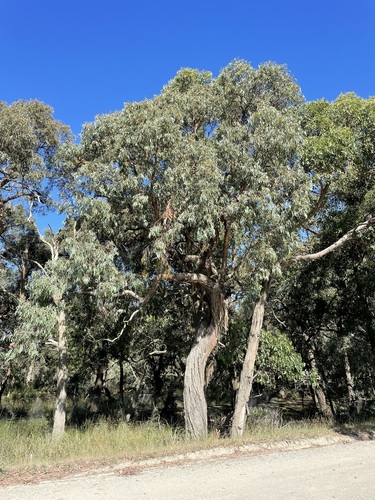
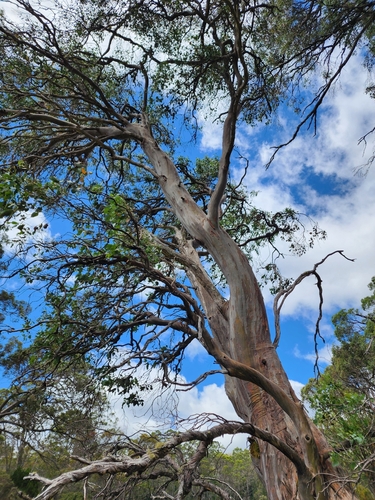
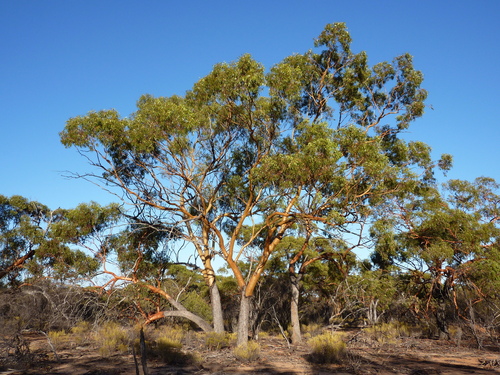
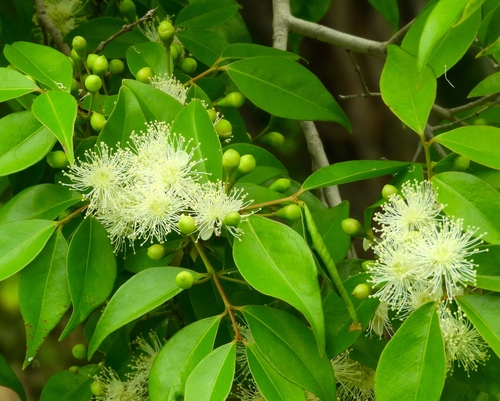
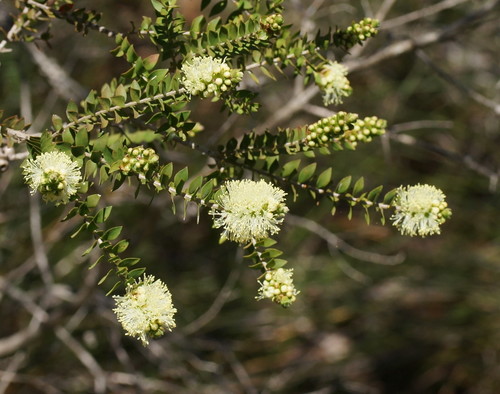
Melaleuca squarrosa Donn is typically a shrub, sometimes a small tree, reaching 0.5 to 10 meters (2 to 30 feet) in height. It has white or grey papery bark. Its leaves are arranged in alternating decussate pairs, forming four rows along the stems. Individual leaves measure 5 to 16.2 millimeters (0.2 to 0.6 inches) long and 2.5 to 8.2 millimeters (0.1 to 0.3 inches) wide. They are flat, linear to narrowly egg-shaped, tapering to a pointed tip, and have between 5 and 7 distinct veins. The cream-colored flowers grow in spikes at the ends of branches, which continue growing after flowering. Each spike holds 4 to 20 individual flowers, reaching up to 22 millimeters (0.9 inches) in diameter and 40 millimeters (2 inches) in length. The petals are 2 to 2.7 millimeters (0.08 to 0.1 inches) long and drop off as the flower matures. There are five bundles of stamens around each flower, each bundle containing 6 to 12 stamens. Flowering occurs mostly in spring or early summer. After flowering, the plant produces woody fruit that are cup-shaped to spherical capsules, measuring 2.7 to 3.5 millimeters (0.11 to 0.14 inches) long. Scrub formed by Melaleuca squarrosa is widespread across the west, north-east and far north-west of Tasmania, where it grows especially in swampy areas. On the Australian mainland, it occurs from areas near Sydney, south through Victoria to the far south-east of South Australia. It grows in heath and dry sclerophyll forest in damp locations within coastal districts and adjacent mountain ranges. In horticulture, this melaleuca makes a useful screen plant, valued for its neat, dense foliage and attractive sweetly-scented flowers.