About Melaleuca squamea Labill.
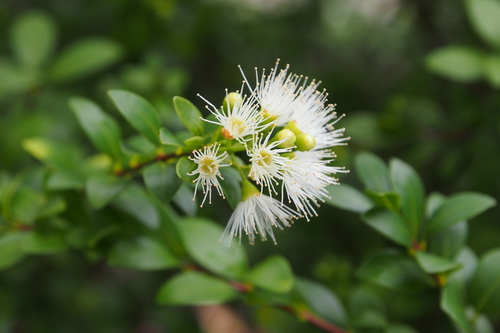
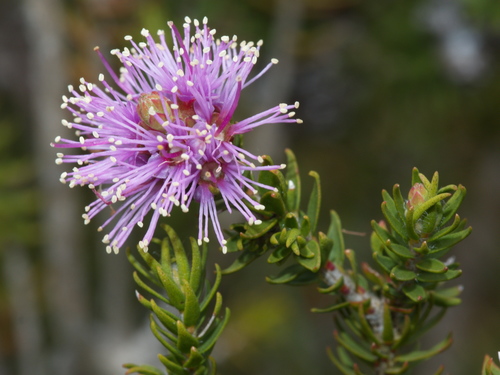
Melaleuca squamea Labill. is a shrub that typically grows to 2 metres (7 feet) high, and sometimes reaches up to 6 metres (20 feet). It has corky or rough, scaly bark, and stiff, rather erect branches. Its leaves are arranged alternately, crowded along the stems, and measure 4.5–12 mm (0.2–0.5 in) long and 1–3 mm (0.04–0.1 in) wide. The leaves are linear to narrow egg-shaped, taper to a soft pointed end, and have between three and five longitudinal veins. The flowers range in colour from lilac to mauve, and are sometimes white or yellowish. They are arranged in heads or short spikes at the ends of branches, which continue growing after flowering. Each flower head holds 3 to 26 individual flowers, and grows up to 20 mm (0.8 in) in diameter. The petals are 1.5–3 mm (0.06–0.1 in) long and drop off as the flower matures. Around the centre of the flower, there are five bundles of stamens, each containing 4 to 9 stamens. Flowering occurs in spring, and after flowering the plant produces woody, almost spherical woody capsules that are 3.5–7 mm (0.1–0.3 in) long. The capsules stay closed on the plant's stems for several years. This melaleuca is widespread across Tasmania, with isolated disjunct populations in south eastern South Australia, south western Victoria, and near-coastal areas of New South Wales from the Tweed River south to Royal National Park. It grows in heath habitat in damp or swampy areas. In horticulture, Melaleuca squamea is useful as a screen or background plant. It is tolerant of frost and drought, and can survive in poorly drained soil. It does not grow well in limy or saline soils, and prefers a sunny position.