About Melaleuca rhaphiophylla Schauer
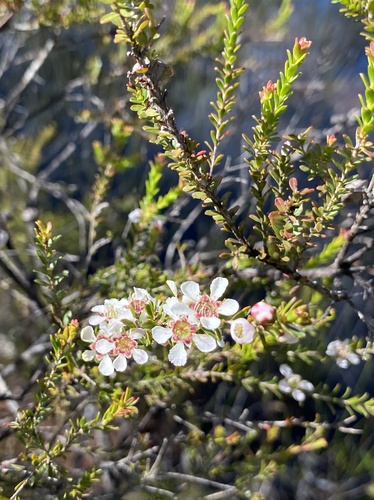
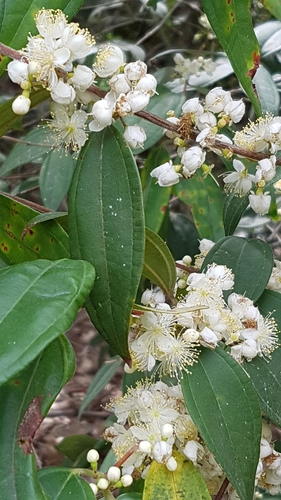
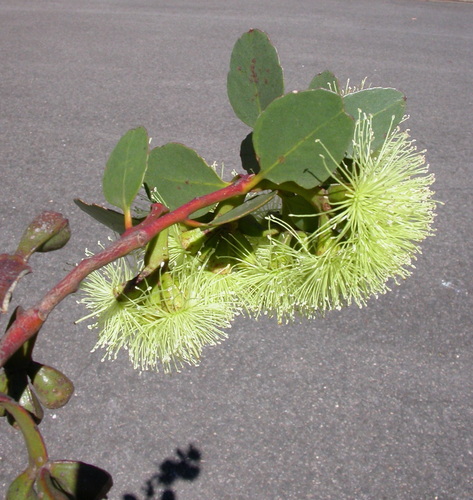
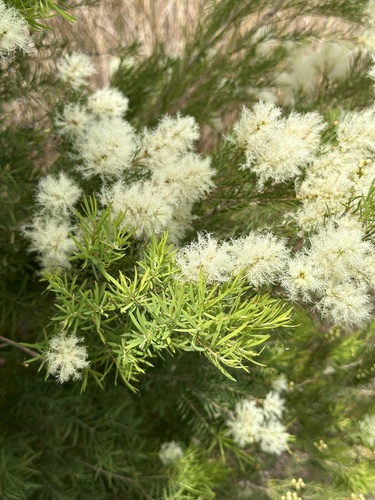
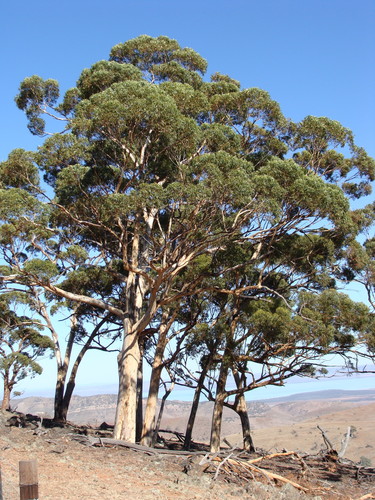
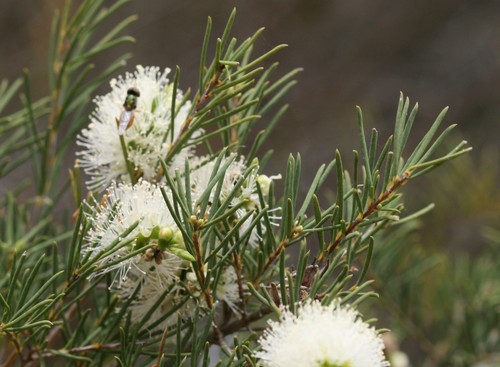
Melaleuca rhaphiophylla is a large shrub or small tree that typically grows up to 10 m (30 ft) tall. It is often multi-stemmed, with a bushy crown and greyish papery bark. Its leaves are soft, arranged alternately along the stems, measuring 8–40 mm (0.3–2 in) long and 0.5–1.5 mm (0.02–0.06 in) wide. The leaves are linear in shape, circular or oval in cross-section, and taper to a hooked point. The flowers range in color from white to cream, and are arranged in heads or spikes at the ends of most branches; the branches continue to grow after flowering, and flowers may also appear in upper leaf axils. The flower heads are up to 27 mm (1 in) in diameter and 40 mm (2 in) long, holding 4 to 25 groups of three flowers each. The petals are 2.5–3.5 mm (0.098–0.14 in) long and fall off as the flower matures. Each flower has five bundles of stamens, with 11 to 25 stamens in each bundle. Flowering occurs spasmodically, mostly from May to January. After flowering, the plant produces woody, cup-shaped capsules that are 3–6 mm (0.1–0.2 in) long and 5–6 mm (0.20–0.24 in) in diameter, held in clusters along the stem. This melaleuca is found in and between the Kalbarri and Albany districts. It grows in sandy or clay soils, sometimes over limestone, near watercourses, in swamps, and in saltmarshes. Melaleuca rhaphiophylla provides food for a range of native animals, and its dense crown offers shelter habitat for fauna. Waterbirds use this species because it often grows in areas that flood during the waterbird breeding season, which deters many predators. Its shallow roots reduce erosion along watercourses, stabilise soils, and trap sediment. In some areas, M. rhaphiophylla is negatively impacted by competition from the introduced plant Typha orientalis, which regrows more vigorously after fire. In horticulture, this melaleuca is a useful shrub for damp locations. It can be used as a screening plant if pruned regularly. Seeds are easily collected from unopened capsules on the plant, and can be grown into tubestock or sown directly into soil.