About Melaleuca quinquenervia (Cav.) S.T.Blake
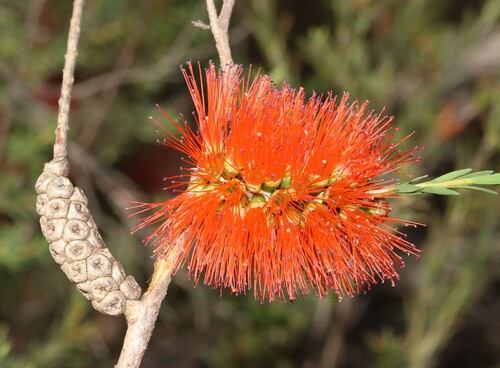
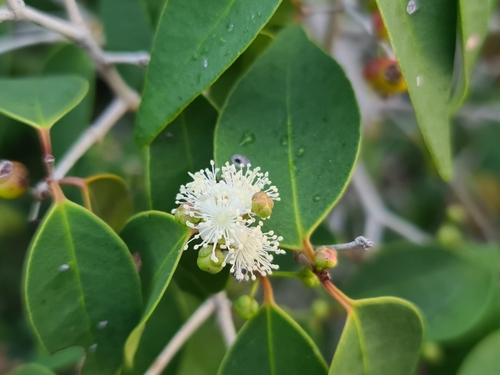
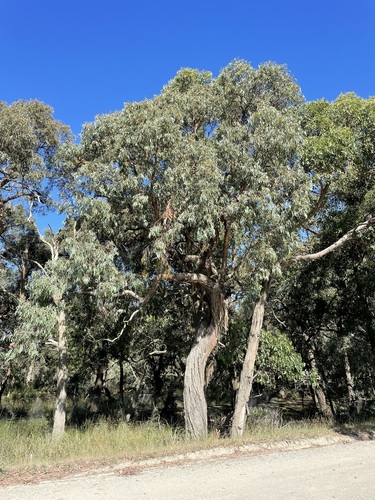
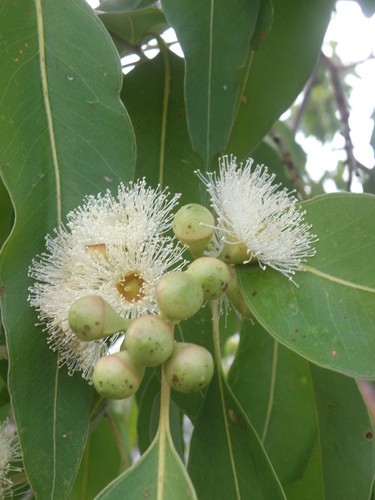
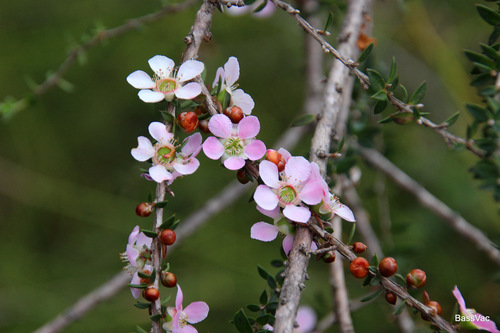
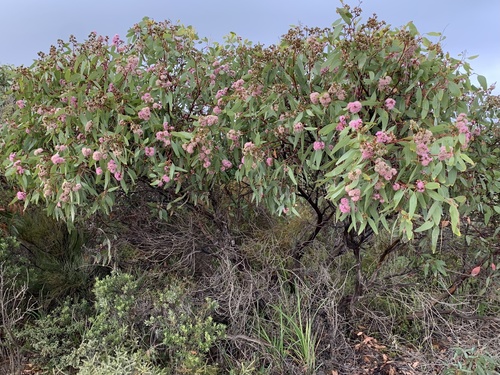
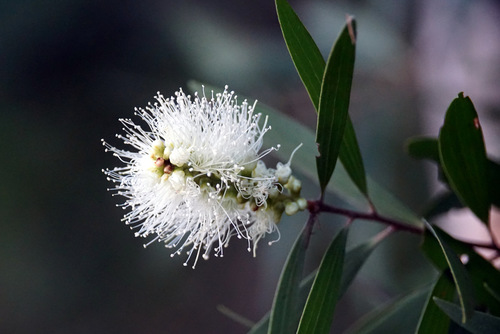
Melaleuca quinquenervia (Cav.) S.T.Blake, commonly known as broad-leaved paperbark, is a small to medium-sized spreading tree. It usually reaches 8–15 m (30–50 ft) in height with a 5–10 m (20–30 ft) spread, though it can occasionally grow as tall as 25 m (80 ft). New young growth is covered in a mix of long and short soft hairs. Its leaves are arranged alternately along branches; they are flat, leathery, lance-shaped to egg-shaped, dull or grey-green, 55–120 mm (2–5 inches) long and 10–31 mm (0.4–1 inch) wide, with a length three to eight times its width. Flowers are arranged in spikes at the ends of branches that continue growing after flowering, and sometimes also appear in upper leaf axils. Each spike holds 5 to 18 groups of three flowers, reaches up to 40 mm (2 in) in diameter, and is 20–50 mm (0.8–2 in) long. The petals are around 3 mm (0.1 in) long and drop off as the flower ages. Stamens are white, cream-coloured or greenish, arranged in 5 bundles around the flower, with 5 to 10 stamens per bundle. Flowering occurs from spring to early autumn, which is September to March in Australia. After flowering, the plant produces woody, broadly cylindrical capsules 2.5–4 mm (0.1–0.2 in) long, that cluster in spike-like groups along branches. Each capsule holds many tiny seeds, which are released annually. In Australia, Melaleuca quinquenervia grows along the east coast, from Cape York in Queensland to Botany Bay in New South Wales. It inhabits seasonally inundated plains and swamps, along estuary margins, and is often the dominant species in these areas. In the Sydney region it grows alongside trees such as swamp mahogany (Eucalyptus robusta) and bangalay (Eucalyptus botryoides). It grows in silty or swampy soil, and has been recorded growing in acid soil with a pH as low as 2.5. It is also native to the southern part of West Papua and Papua New Guinea. It is widespread across New Caledonia, including Grand Terre, Belep, Isle of Pines and Maré. It grows as part of savannah in western New Caledonia, where scattered trees grow across grassland, and its spread through this landscape may have been helped by human-managed fire regimes. Major threats to Melaleuca quinquenervia include housing developments, roads, sugar cane farms and pine plantations. Remaining populations of the species in Australia are not protected in reserves, with most of its woodland habitat located on private land where clearing continues. This species has been introduced as an ornamental plant to many tropical regions around the world, including Southeast Asia, Africa and the Americas, and has become an invasive weed in many of these areas. Melaleuca quinquenervia resprouts vigorously from epicormic shoots after bushfire, and has been recorded flowering just weeks after being burnt. Individual trees can live for over 100 years; 40-year-old cultivated trees have been recorded reaching a trunk circumference of 2.7 m (9 ft). Its flowers are a rich source of nectar for many organisms, including fruit bats, a wide range of insects, and bird species such as the scaly-breasted lorikeet (Trichoglossus chlorolepidotus). The grey-headed flying fox (Pteropus poliocephalus) and little red flying-fox (Pteropus scapulatus) consume its flowers. Traditionally, the paper-like bark of this species is used to make coolamons, build shelters, wrap baked food, and line ground ovens. Nectar is traditionally extracted by washing it in water-filled coolamons, and the resulting mixture is consumed as a sweet beverage. Scented flowers produce honey that ranges from light to dark amber depending on the growing region. This honey has a strong flavour, candies easily, and while it is not considered high-quality, it is widely popular. Melaleuca quinquenervia is sometimes used to grow bonsai, and its water-tolerant timber is used for fence construction. It is often planted as a street tree or in public parks and gardens, especially in Sydney. In its native Australia, it works very well as a windbreak, screening tree, and food source for a wide range of local insect and bird species, and can tolerate waterlogged soils.