About Melaleuca linariifolia Sm.
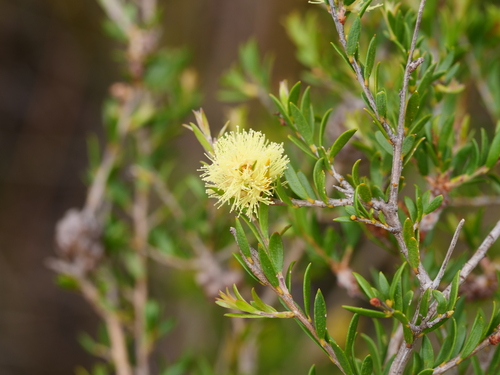
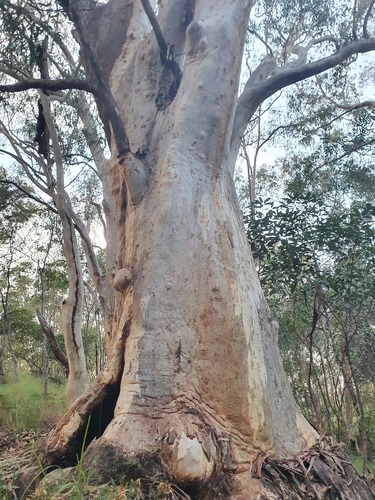
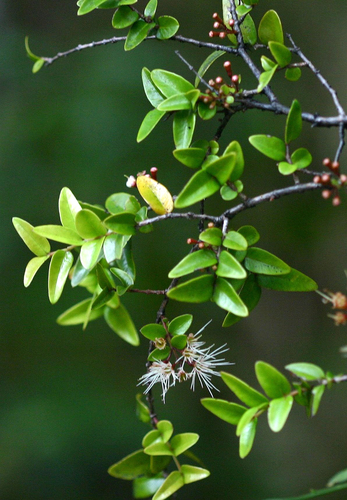
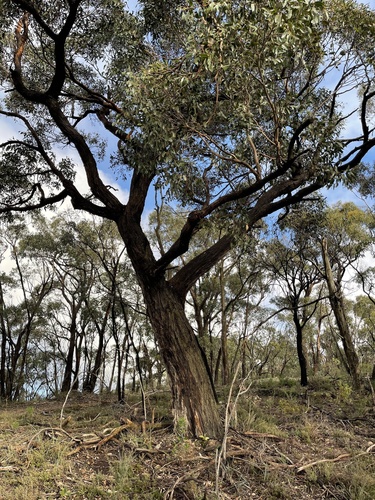
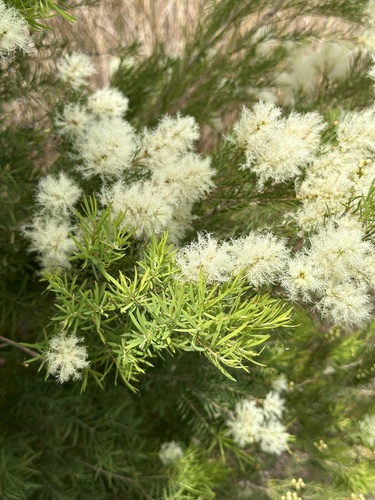
Melaleuca linariifolia Sm. is a small tree that reaches a height of 6 to 10 meters (20 to 30 feet). It has distinctive, attractive white or creamy white papery bark, and a dense canopy. Its leaves are arranged in alternating decussate pairs, and are glabrous except when very young. Leaves measure 17 to 45 millimeters (0.7 to 2 inches) long, and 1 to 4 millimeters (0.04 to 0.2 inches) wide. They are linear to lance-shaped, and have a distinct mid-vein. The flowers of this species are white to creamy-white, scented, and arranged in spikes on the ends of branches; branches continue to grow after flowering, and flowers sometimes also appear in upper leaf axils. Each spike is up to 40 millimeters (2 inches) wide and long, and holds 4 to 20 individual flowers. The petals are 2.5 to 3.3 millimeters (0.1 to 0.1 inches) long, and fall off as the flower matures. Stamens are arranged in five bundles around each flower, with 32 to 73 stamens per bundle. Flowering occurs over a relatively short period between October and February, and covers the entire tree. After flowering, the tree produces woody capsule fruits. Fruits measure 2.5 to 4 millimeters (0.1 to 0.2 inches) long, and 4 to 5 millimeters (0.16 to 0.20 inches) long, and are scattered along stems. The capsule valves do not project beyond the rim of the capsule. This species, commonly called snow-in-summer, is distributed from the Maryborough district in Queensland to Bawley Point in the Ulladulla district in New South Wales. There is also a separate disjunct population in Blackdown Tableland National Park, Queensland. It grows in heath and dry sclerophyll forest habitats, most commonly near watercourses or swamps.