About Melaleuca leucadendra (L.) L.
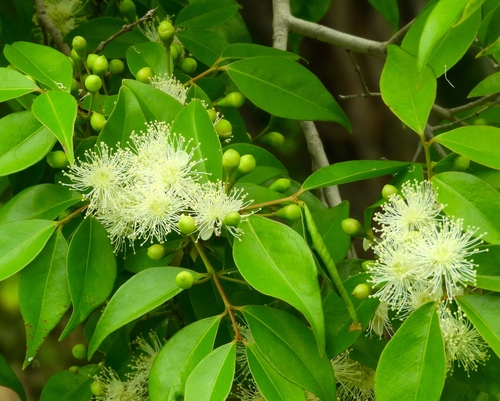
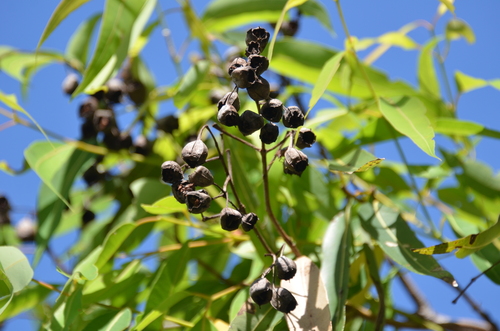
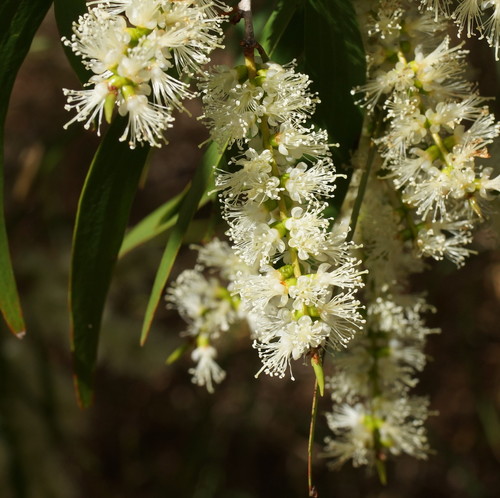
Melaleuca leucadendra, formally Melaleuca leucadendra (L.) L., is a large tree. It is usually under 20 m (70 ft) tall, but sometimes grows taller than this height. It has thick, papery bark that is most often white, but may also be pinkish or cream-colored, and it has weeping branches. When leaves and young branches are young, they are covered in fine, short, white hairs, and become glabrous as they reach maturity. Leaves are arranged alternately, are 75–270 mm (3–10 in) long and 6.5–40 mm (0.3–2 in) wide, and are flat, narrow egg-shaped or lance-shaped, tapering to a sharp point. Leaves have 5 longitudinal veins, sometimes up to 9, and are often curved or shaped like a sickle. The flowers are cream, white, or greenish-white, and arranged in spikes at the ends of branches that continue growing after flowering. They sometimes grow on the sides of branches or in upper leaf axils. Each spike grows up to 35 mm (1 in) in diameter and up to 80 mm (3 in) long, and holds between 7 and 22 groups of three flowers each. Petals are 3–4 mm (0.1–0.2 in) wide and drop off shortly after the flower opens. Stamens are arranged in five bundles around each flower, with each bundle holding between 5 and 12 stamens. Flowering can happen at any time of year, and is followed by woody capsule fruit that is 3.9–4.9 mm (0.15–0.19 in) long, growing in loose clusters along stems. This species is widely distributed across northern Western Australia, the Northern Territory, and Queensland, Australia, reaching as far south as Shoalwater Bay. It also grows naturally in New Guinea and the Maluku Islands of Indonesia. It grows in forests near the edges of rivers and streams, across a range of soil types. Aboriginal people have several traditional uses for this tree. They cut strips of its bark and tied them to frames made of Dodonaea branches to build waterproof huts. They wrapped food in the bark before cooking it in an underground oven called a kap mari, and also used it to wrap the bodies of deceased people. Bark taken from the trunks of very large trees was used to make bark canoes. Crushed leaves of the tree were used to treat respiratory infections, and its flowers were used to make a sweet drink.