About Melaleuca lateritia Otto & A.Dietr.
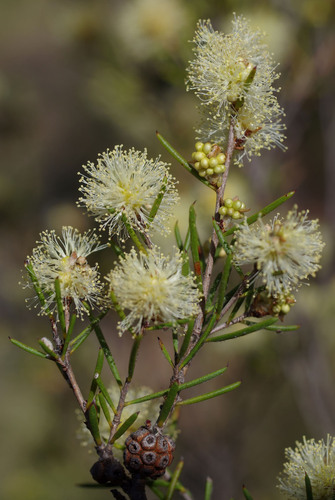
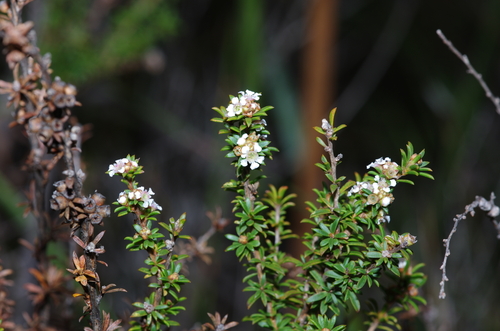
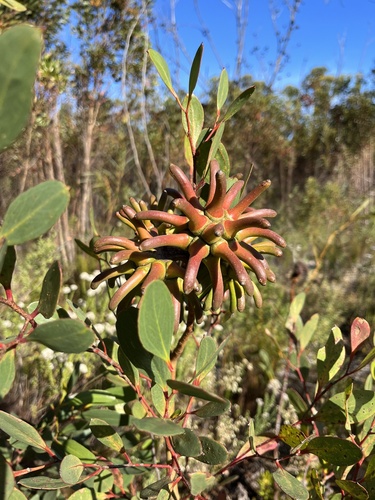
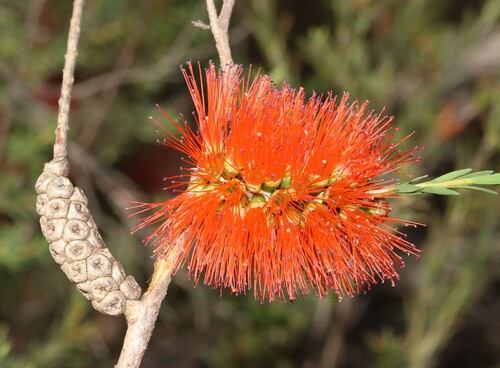
Melaleuca lateritia Otto & A.Dietr. is an erect shrub that grows to about 2.5 meters (8 feet) high and up to 3 meters (10 feet) wide. Its leaves are light green, thin, linear, concave, glabrous, and have a pointed tip. They measure 6–25 millimeters (0.2–1 inch) long and 1–2 millimeters (0.04–0.08 inch) wide, and are arranged spirally around the plant stem. This species produces bright orange-red flowers arranged in spikes up to 80 millimeters (3 inches) long and 60 millimeters (2 inches) in diameter. The spikes grow on lateral branches from old wood, and the stem continues growing beyond the flower spikes. Flowering occurs over an extended period from August to April. After flowering, it produces woody capsule fruits around 6–8 millimeters (0.2–0.3 inches) in diameter, which remain closed for many years without releasing their seeds. Commonly called robin redbreast bush, this plant occurs in the Geraldton Sandplains, Jarrah Forest, Swan Coastal Plain, and Warren biogeographic regions of Western Australia, where it grows in sandy soil in swampy areas. Melaleuca lateritia is widely cultivated and well established in general horticulture. Although it is native to a climate with dry summers, it is one of the more adaptable melaleucas to the wetter summer conditions of Australia's east coast. It grows best in well-drained soil in a sunny position, responds well to pruning to maintain its shape, and benefits from annual fertilising at the end of the flowering season. In Canberra, honeyeaters especially the eastern spinebill and New Holland honeyeater visit the flowers of this species.