About Melaleuca hypericifolia Sm.
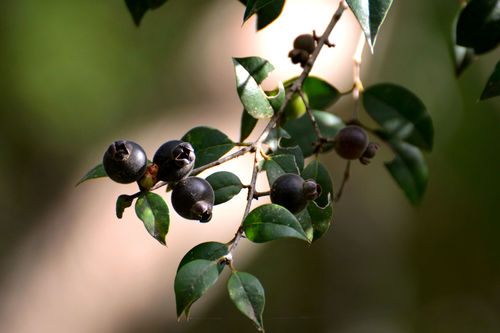
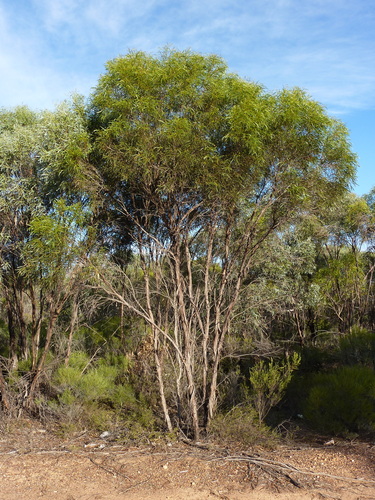
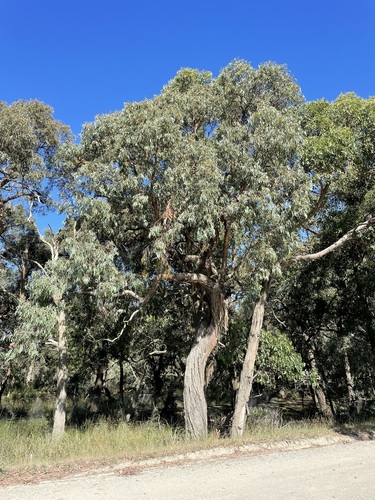
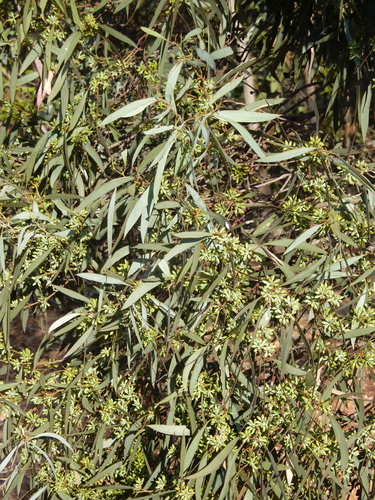
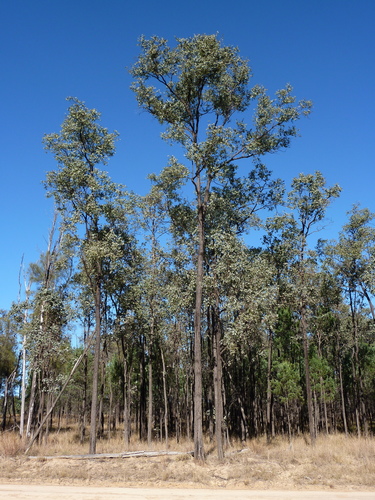
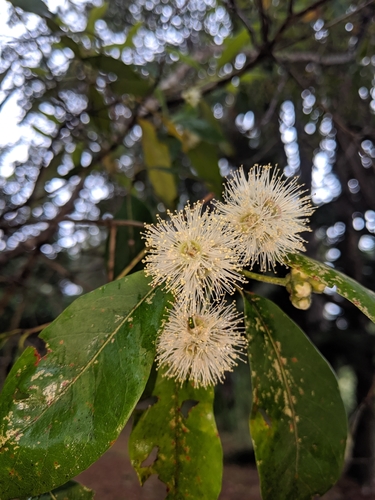
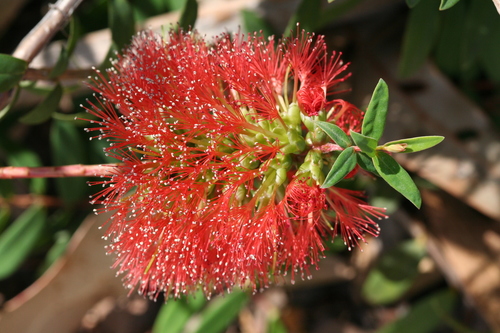
Melaleuca hypericifolia Sm. is a large woody shrub or small tree that grows up to 6 metres (20 feet) tall and has greyish papery bark. Its leaves are arranged in alternating opposite pairs (an arrangement called decussate), are 10–40 mm (0.4–2 in) long and 4–10 mm (0.2–0.4 in) wide, and are narrow elliptic in shape with a central groove on the upper surface. The flowers of this species are red to orange, arranged in a spike that usually grows on older wood. The flower spike can reach up to 60 mm (2 in) in both diameter and length, and holds up to 40 individual flowers. The petals are 4.5–7 mm (0.2–0.3 in) long and drop off as the flower ages. Stamens are arranged in five bundles around each flower, with between 16 and 25 stamens in each bundle. Flower spikes appear in spring and summer, and are followed by woody, oval-shaped capsule fruits that are 5–6.5 mm (0.2–0.3 in) long. The sepals of the flower remain as small teeth around the rim of the capsule, and capsules become compressed together as the plant ages. This species occurs in damp areas of sandy heath and woodland, mostly in coastal regions from Bermagui to Sydney, and extends inland as far as the Blue Mountains. It has also become naturalised in South Australia and Victoria. Commonly called hillock bush, this plant is a hardy, adaptable, attractive shrub that has been grown in gardens for many years. It is moderately tolerant of frost, though its flowers are usually hidden inside the shrub. It makes a dense screening plant when unpruned, but can be pruned to display its flowers. It has become invasive in some areas after spreading from gardens into nearby bushland in other Australian states, so special care should be taken when planting this species in southern Victoria. Two horticultural cultivars have been developed: Melaleuca hypericifolia 'Snapper Point' and Melaleuca hypericifolia 'Ulladulla Beacon'.