About Melaleuca huegelii Endl.
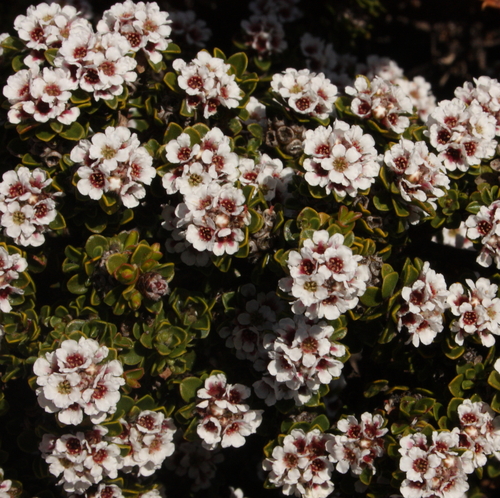
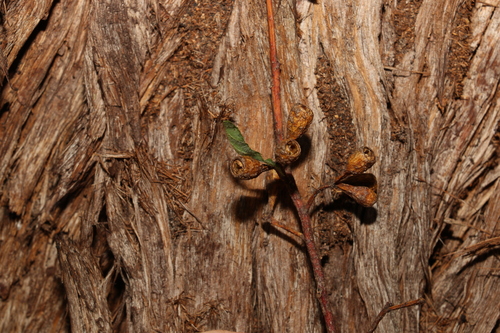
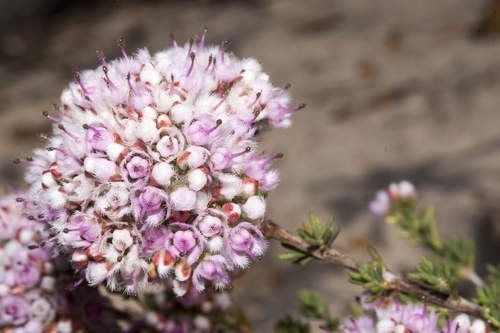
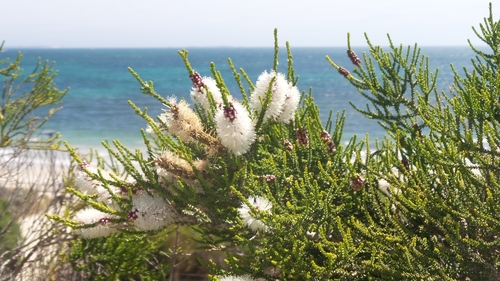
Melaleuca huegelii Endl. is most often a large shrub, and sometimes grows as a small tree reaching up to 5 metres (20 feet) in height. It has dark-coloured bark, and its branches are usually covered in fine, soft hairs, at least when the branches are young. Its leaves measure 1.3 to 10 millimetres (0.05 to 0.4 inches) long and 1 to 2.5 millimetres (0.04 to 0.1 inches) wide, with a roughly egg-shaped outline that tapers to a pointed tip. The flowers can be white, cream-coloured, or any shade of pink, and they are arranged in spikes. These spikes grow at the ends of branches, which continue growing after flowering ends, and sometimes also form in the upper leaf axils. The flower spikes are up to 100 millimetres (4 inches) long, sometimes even longer, and up to 25 millimetres (1 inch) in diameter. They hold up to 140 groups of three flowers each. The petals measure 1.5 to 3 millimetres (0.06 to 0.1 inches) long and fall off as the flowers mature. The stamens are arranged in five bundles around the center of the flower, with 6 to 13 stamens contained in each bundle. Flowering takes place between August and January. After flowering, the plant produces woody, cup-shaped capsule fruits that are 2.3 to 2.8 millimetres (0.09 to 0.1 inches) long and wide, growing in clusters along the stem. This species occurs along the coast of Western Australia, ranging from the Shark Bay district to the Augusta district. It grows in coastal habitats, including limestone cliffs, dunes, and plains.