About Melaleuca halmaturorum F.Muell. ex Miq.
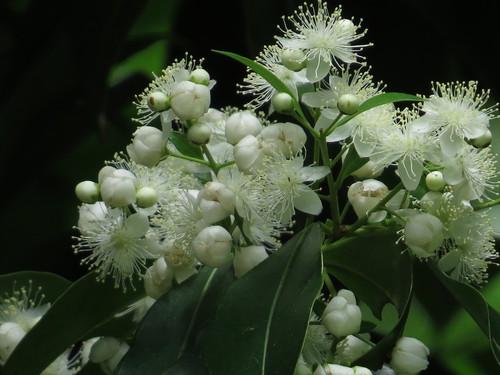
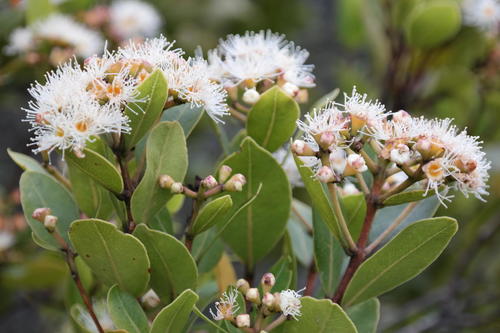
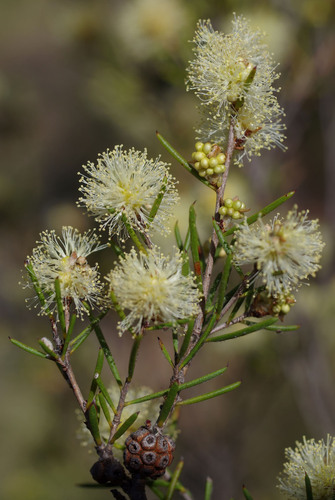
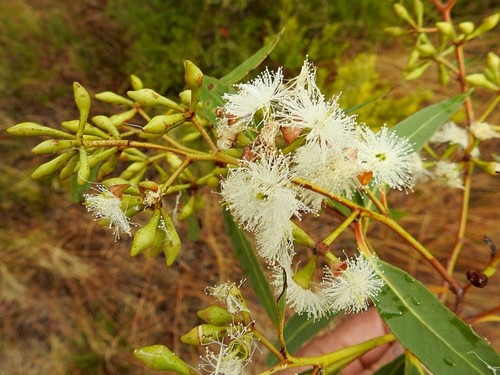
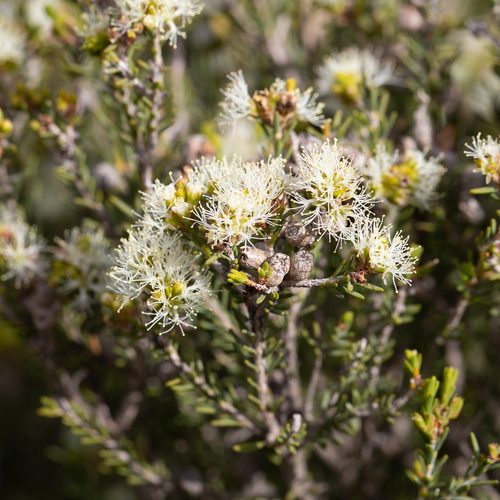
Melaleuca halmaturorum F.Muell. ex Miq. is a slow-growing shrub or small tree that eventually reaches a height of 6–8 metres (20–30 feet). It typically has a crooked, straggling, irregular, or untidy growth form, and bears creamy-grey, papery bark. Its leaves are dark green and glabrous, arranged in decussate pattern—alternate pairs positioned at right angles to the pairs above and below them—forming four distinct rows of leaves along the stem. The leaves are linear to lance-shaped, measuring 2.6–9 millimetres (0.1–0.4 inches) long and 0.7–1.8 millimetres (0.03–0.07 inches) wide, with many distinct oil glands on the lower surface, and a leaf stalk approximately 1 millimetre (0.04 inches) long. Its flowers are white or cream, arranged in heads that sometimes grow at the end of branches that continue growing after flowering, and also appear in upper leaf axils. The flower heads reach up to 15 millimetres (0.6 inches) in diameter and hold up to five individual flowers. Flower buds are surrounded by brown, papery bracts that fall off as the flowers open. The petals are 2–4 millimetres (0.08–0.2 inches) long and drop off as the flowers age. Stamens are arranged in five bundles around each flower, with usually 6 to 17 stamens per bundle. Flowering occurs between August and October. The fruit that develops after flowering is woody, cup-shaped capsules 3–5.5 millimetres (0.1–0.2 inches) long and wide, arranged in loose clusters along the stem. These clusters remain attached to the stem for several growing seasons. This species occurs in southern regions of Western Australia, South Australia, and Victoria. In Western Australia, it is found in the Eremaean and South-West botanical provinces. In South Australia, it grows in the Eyre Peninsula, Murray, Yorke Peninsula, Southern Lofty, Kangaroo Island, and South-Eastern bioregions. In Victoria, it occurs in the Mallee, Loddon Murray, Central and Northern, and Wimmera bioregions, where it is becoming rare due to invasion by tall wheat grass (Lophopyrum ponticum). Melaleuca halmaturorum is salt-tolerant, and is most often found in swampy, waterlogged habitats including estuaries, coastal dunes, and the fringes of salt lakes. In horticulture, this species is a very hardy plant when grown in full sun. It is often used in revegetation projects to remediate and stabilise saline sites.