About Melaleuca gibbosa Labill.
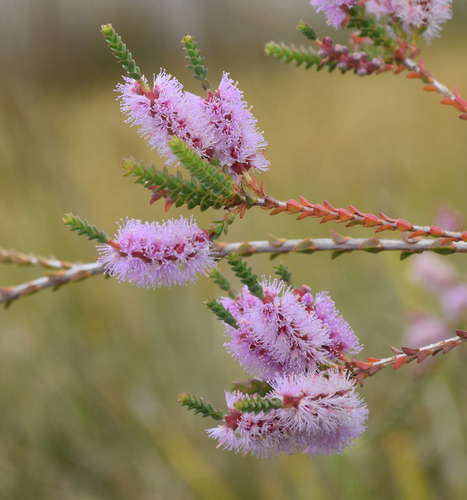
Melaleuca gibbosa is a medium-sized shrub that grows about 2 meters (7 feet) tall and wide. Its leaves are egg-shaped, measuring 2–7 mm (0.08–0.3 in) long and 2–4 mm (0.08–0.2 in) wide. The leaves are stalkless, arranged in crowded, alternating opposite pairs along the stem, a growth pattern known as decussate. This species produces mauve flowers that form dense, cylindrical spikes around 15 mm (0.6 in) long, each spike holding up to around ten pairs of flowers. The conspicuous stamens are 3.5–5.5 mm (0.1–0.2 in) long, arranged in five bundles around each flower, with between 5 and 25 stamens per bundle. Flowering occurs mainly from November to December, but often happens at other times of the year. The fruit are woody capsules around 5 mm (0.2 in) across, wider at the base where they become embedded in the woody stem. Seeds remain held inside the capsules until the plant, or the portion of the plant containing the capsules, dies. Commonly called slender honey-myrtle, this plant occurs along the coasts of South Australia, Victoria and Tasmania, as well as on Kangaroo Island and Flinders Island. It grows in heath in swampy areas and in scrub, ranging from sea level up to approximately 1,500 m (5,000 ft). It grows vigorously in exposed sites such as Cape Bruny at the southern tip of Bruny Island and Hurricane Heath on the Tasman Peninsula. This melaleuca species provides food for some caterpillar species, including the caterpillars of the tactile tuft-moth Aquita tactalis (Walker, 1863). In cultivation, M. gibbosa is a very hardy plant suitable for most soils and growth conditions. It is drought hardy, frost tolerant, and can tolerate waterlogging. It can be easily propagated from seed collected from one- or two-year-old capsules, or from semi-hardwood cuttings.