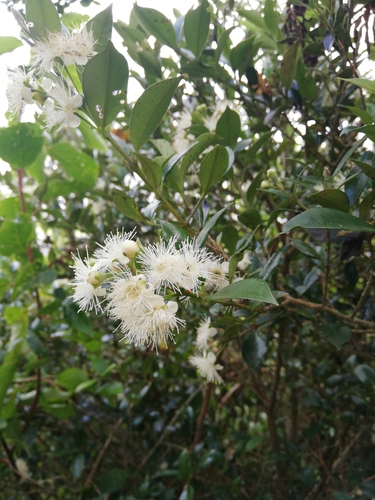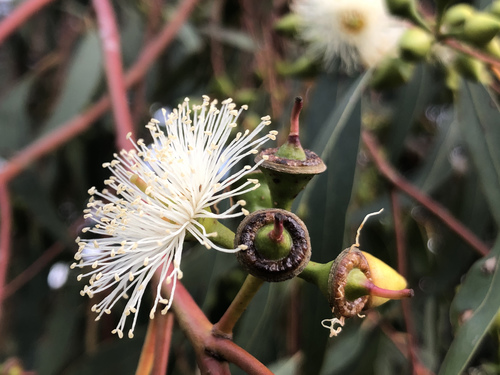
About Melaleuca ericifolia Sm.
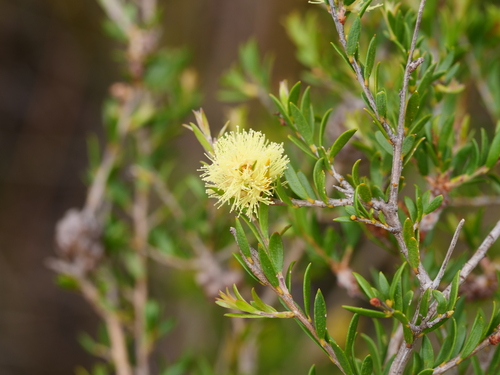
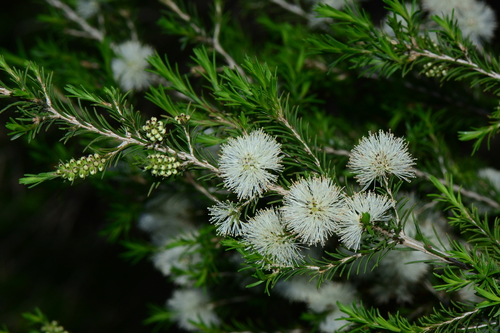
Melaleuca ericifolia Sm. is commonly known as swamp paperbark. It typically grows as a tall, dense shrub, and sometimes reaches the size of a tree up to 9 metres (30 feet) in height. It has pale white or brownish papery bark. Its leaves are arranged alternately, and sometimes arranged in whorls of three. The leaves are dark green and linear in shape, measuring 5–18 mm (0.2–0.7 in) long and 0.5–1.7 mm (0.02–0.07 in) wide. The flowers of Melaleuca ericifolia are creamy-white, arranged in heads or spikes at the ends of branches; the branches continue to grow after flowering. The spikes are up to 20 mm (0.8 in) in diameter and 25 mm (1 in) long, and hold between 10 and 40 individual flowers. The petals are 1.2–2.2 mm (0.05–0.09 in) long and drop off as the flowers mature. Stamens are arranged in five bundles around each flower, with each bundle containing 7 to 14 stamens. In this species' native range, flowering occurs from October to November. Flowering is followed by the development of fruit, which are woody capsules. The capsules are 2.5–3.6 mm long and 3–5 mm in diameter, arranged in oblong cylinders along the stems. Swamp paperbark is distributed in near-coastal areas from New South Wales south of Port Macquarie to Port Philip Bay in Victoria. It also occurs on the islands of Bass Strait, and is common in coastal areas of northern, north-eastern and western Tasmania. It grows alongside streams and in coastal swamps within heath and dry sclerophyll forest. Swamp drainage and land clearance have significantly reduced populations of this species in Victoria. This melaleuca produces fragrant flowers that attract birds. It is a clonal species, and this characteristic has been used in efforts to improve the efficiency of rehabilitating swampy areas with the species. Aboriginal people traditionally used the bark of this tree for paintings, blankets, and shelter roofing. Its wood was used to make spears, clubs and digging sticks. Leaf oil was used for medicinal purposes, and flower nectar was used to make sweet drinks. Today, the foliage of this species is used for brushwood fencing, and in aviaries it provides nesting sites for birds such as finches.