About Melaleuca decussata R.Br.
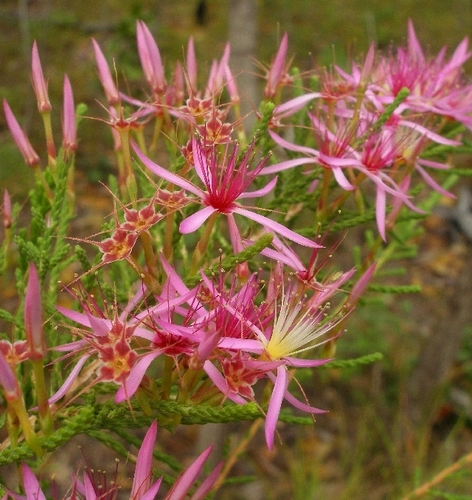
Melaleuca decussata R.Br. is a densely branched shrub that reaches both a height and width of 3 metres (10 feet). Its leaves are arranged in alternating pairs, positioned at right angles to the pairs of leaves above and below them, forming four distinct rows along the stems, an arrangement called decussate. Individual leaves are 4.5–15 millimetres (0.2–0.6 inches) long and 0.5–3 millimetres (0.02–0.1 inches) wide. Their shape can be linear, narrowly elliptic, or narrow egg-shaped that tapers to a point, and they are concave in cross section. Prominent oil glands are visible on the lower surface of the leaves. Flowers of this species are pink or purple, and they fade quickly to white after opening. The flowers form spikes that grow on the ends of branches (which continue growing after flowering) and also on the sides of branches. These flower spikes are up to 16 millimetres (0.6 inches) in diameter, 20–30 millimetres (0.8–1 inch) long, and hold between 6 and 22 individual flowers. The petals are 1.8–2.3 millimetres (0.07–0.09 inches) long, and drop off as the flower ages. Stamens are arranged in five bundles around each flower, with 12 to 26 stamens per bundle. The flowering season runs from August to May overall, but most flowers bloom from November to February within the species' native range. After flowering, the plant produces woody capsule fruits, which are characteristically fused together at their bases and sunken into the stem.
In terms of distribution and habitat, Melaleuca decussata occurs between the coastal areas of South Australia (including the Eyre Peninsula) and the centre of eastern Victoria.
In horticulture, Melaleuca decussata is a hardy garden plant with attractive foliage. It can grow well in most garden situations, and produces attractive mauve flowers that fade quickly to white. It is not recommended to plant this species within 6 metres (20 feet) of a wastewater pipe, as it has the potential to cause damage to the pipe.