About Melaleuca armillaris (Gaertn.) Sm.
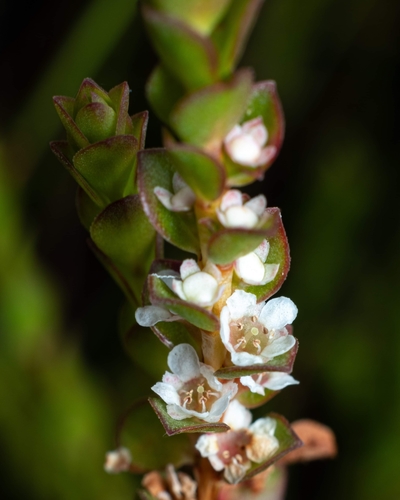
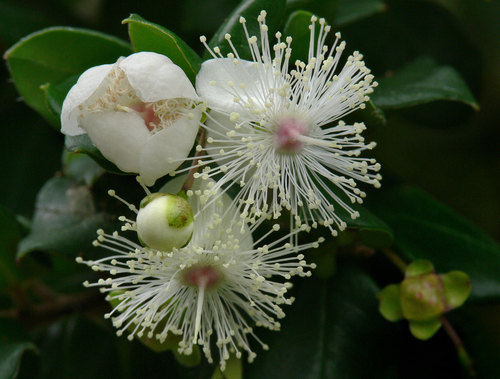
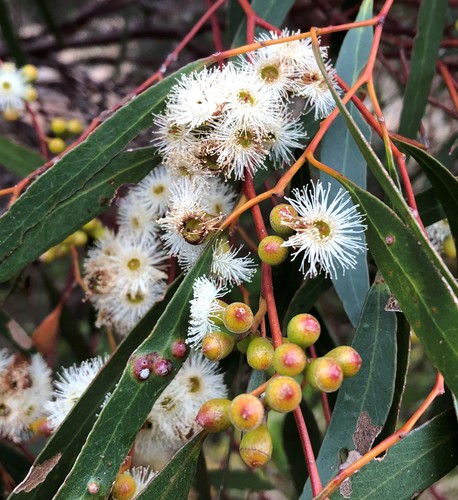
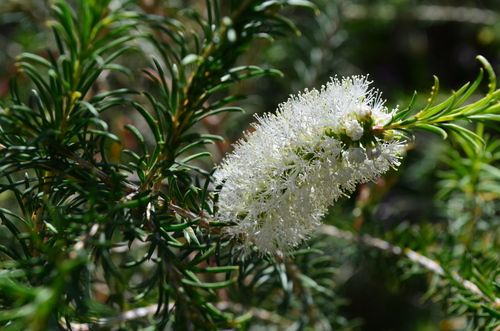
Bracelet honey myrtle (Melaleuca armillaris) grows as a large shrub to small weeping tree, reaching up to 8 m (30 ft) in height. It has rough, grey fibrous bark, distinctive decumbent branching, and dense foliage. Its leaves are typically arranged in alternating decussate pairs, positioned at right angles to the pairs above and below, which makes them appear to form four rows along the stem. One source notes the leaves as spirally arranged, while another describes them as alternate. Mature leaves are glabrous, measuring 4.5–19 mm (0.2–0.7 in) long and 0.8–4 mm (0.03–0.2 in) wide. They are linear to narrow oval in shape, with a tip that tapers to a distinct hook. The plant's flowers are most commonly white, sometimes cream-coloured, and rarely pink. They are arranged in cylindrical spikes on the sides of branches, often on older wood. The spikes grow up to 50 mm (2.0 in) long and 25 mm (0.98 in) in diameter, and hold a large number of individual flowers. The petals are 1.5–3 mm (0.06–0.1 in) long and drop off as the flower matures. Stamens are arranged in five bundles called staminal claws, which are 3–4.9 mm (0.1–0.2 in) long, with each bundle containing 8 to 18 stamens. Flowering occurs mostly from spring to early summer, and is followed by woody capsule fruits. The capsules are 2.3–4.5 mm (0.09–0.2 in) long and about 5 mm (0.2 in) in diameter, and grow in cylindrical clusters along the branches. Subspecies armillaris is native to coastal areas from south of the Manning River district in New South Wales to far eastern Victoria, some Bass Strait islands including Curtis Island, and the far north eastern corner of Tasmania. It is also naturalised in other parts of Victoria, the Australian Capital Territory, southern South Australia, and south-western Western Australia, and is especially common on the far south coast of New South Wales. It naturally grows on coastal headlands and clifftops, often in dense heath. Subspecies akineta is only found in the Gawler Ranges of South Australia, where it grows on ridges and granite outcrops. This melaleuca is considered a serious environmental weed in some locations, particularly in Victoria. It displaces native species, increases fuel loads that make areas more prone to bushfires, and this problem worsens after fire because the plant releases large numbers of seeds following a burn. In South Australia, it is a problematic weed in the Mount Lofty Ranges, Adelaide Hills, and Kangaroo Island. In Western Australia, it causes problems in the coastal areas of the state's south-west. Bracelet honey myrtle is a preferred food source for certain sawfly species (order Hymenoptera, suborder Symphyta), especially the long-tailed sawfly Pterygophorus facielongus, which can rapidly defoliate an entire tree. Melaleuca armillaris has the potential to become a weed outside of its native range, and is classed as a serious environmental weed in Victoria and South Australia, where it can increase fuel loads and raise the risk of fire. In horticulture, Melaleuca armillaris is cultivated as a fast-growing windbreak or screening plant. It is hardy, grows in most soils and aspects, is resistant to salt spray, and is suitable for planting under power lines.