About Melaleuca alternifolia (Maiden & Betche) Cheel
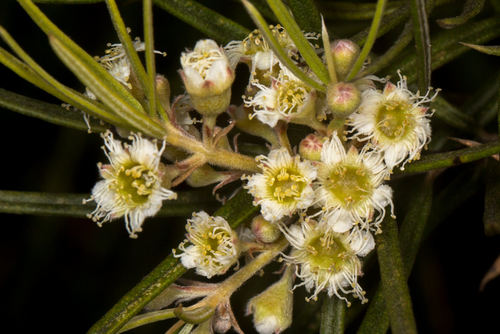
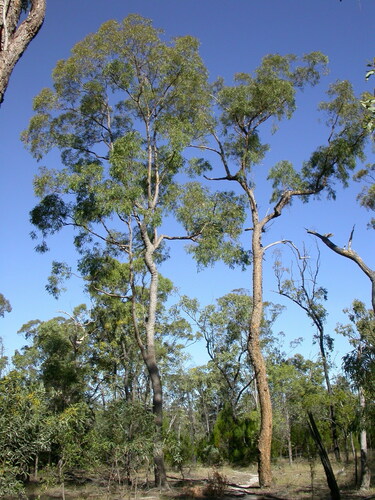
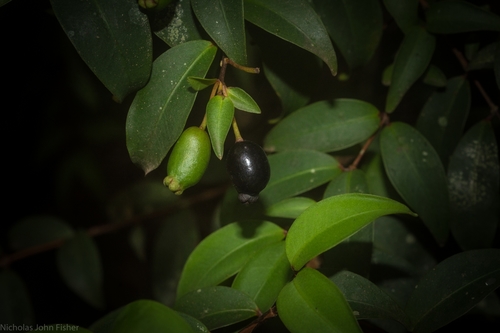
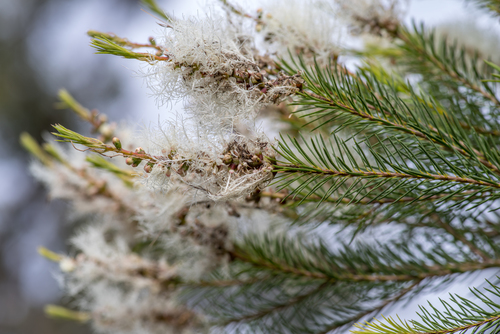
Melaleuca alternifolia (Maiden & Betche) Cheel is a small tree that reaches roughly 7 meters (20 feet) in height. It has a bushy crown and whitish, papery bark. Its leaves are arranged alternately, sometimes scattered or arranged in whorls. They are smooth, soft, linear in shape, between 10 and 35 millimeters (0.4 to 1 inch) long, and 1 millimeter (0.04 inch) wide. The leaves are oil-rich, with clearly visible oil glands. White or cream-colored flowers grow in spiked clusters 3 to 5 centimeters (1 to 2 inches) long, flowering over a short period mostly from spring to early summer. These flower clusters give the tree a fluffy overall appearance. Small, woody, cup-shaped fruits, 2 to 3 millimeters (0.08 to 0.1 inch) in diameter, are scattered along the tree's branches. This species is endemic to Australia. Its range extends from the Grafton district in New South Wales inland as far as Stroud, and north through coastal districts to Maryborough in Queensland. It grows along streams and in swampy areas. Indigenous Australians of eastern inland Australia have used this plant, commonly called tea tree, as a folk medicine. They inhale oil from crushed leaves to treat coughs and colds, sprinkle leaves on wounds before applying a poultice, and soak leaves to create an infusion for sore throats or skin conditions. Like other members of the myrtle family Myrtaceae, this species is used to distill essential oil. It is the main species grown for commercial production of tea tree oil, also called melaleuca oil, which is used as a topical treatment. Tea tree oil is commonly used to treat acne, though there is limited evidence supporting its effectiveness for this purpose. If ingested, tea tree oil is toxic and can cause serious side effects including coma. It may also cause skin irritation when used topically in high concentrations. As of 2006, no deaths related to tea tree oil exposure had been reported in medical literature.