About Melaleuca acuminata F.Muell.
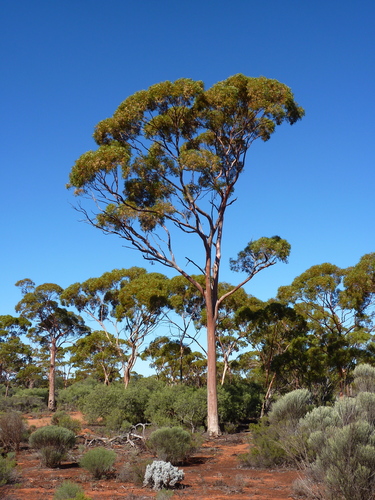
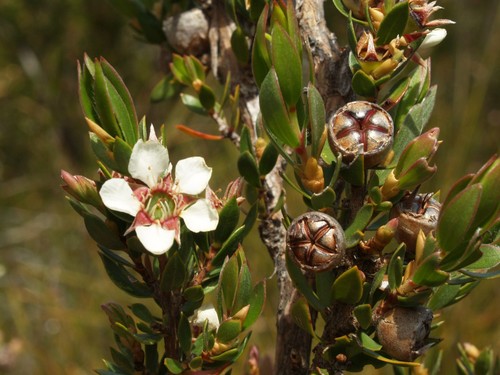
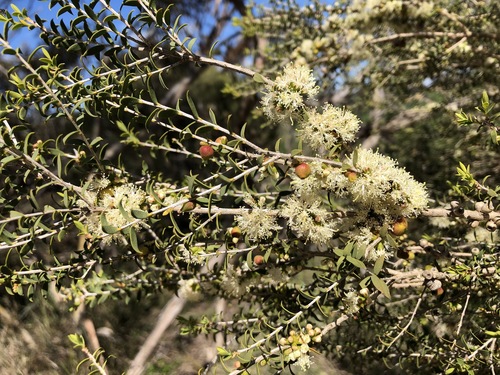
Melaleuca acuminata F.Muell., commonly known as mallee honeymyrtle, is an erect, fairly open shrub with papery or fibrous bark and numerous ascending branches. Its leaves are arranged in alternating opposite pairs (decussate) on either side of the stem, are narrow elliptic in shape, 5–10 mm (0.2–0.4 in) long, 2–4 mm (0.08–0.2 in) wide, and have a short petiole. The flowers are cream or white, sometimes tinged with pink, and arranged in clusters of three to six. These clusters form along the stem over a considerable length. The stamens are grouped into five clusters, called "claws", with 9 to 17 stamens per claw. Flowering occurs in spring, and is followed by the development of fruit: smooth, woody capsules 3–5 mm (0.1–0.2 in) in diameter, borne either singly or in small clusters. This species occurs in Western Australia across the Carnarvon, Coolgardie, Avon Wheatbelt, Esperance, Jarrah Forest and Mallee biogeographic regions; in South Australia it is found only in the far south-eastern corner of the state; in western Victoria it grows in the Murray Mallee, Lowan Mallee, Wimmera, Goldfields and Greater Grampians biozones; and in New South Wales it is rare, occurring only in the Balranald district. It grows in mallee communities on sandhills in New South Wales; elsewhere, it grows in sandy or clayey soils in swampy depressions or on rises, very often in saline conditions. In horticulture, this melaleuca is adaptable and easy to grow. When supplied with ample water, it grows more vigorously than it typically does in its wild habitat.