About Megisba malaya (Horsfield, 1828)
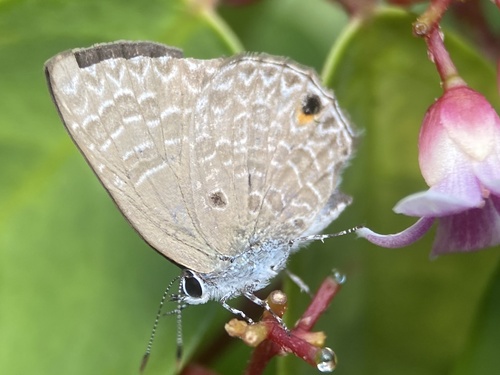
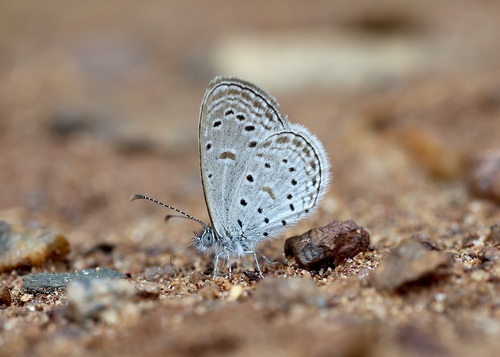
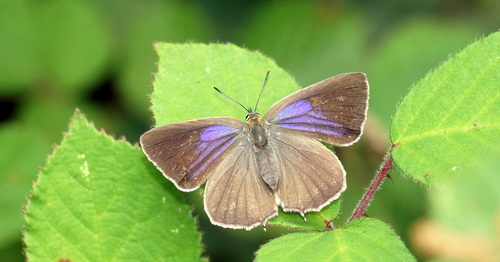
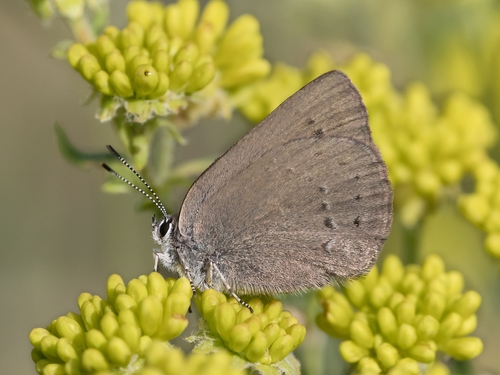
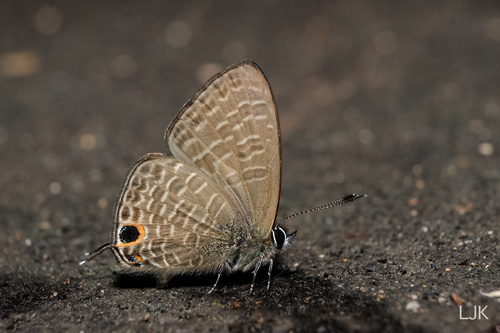
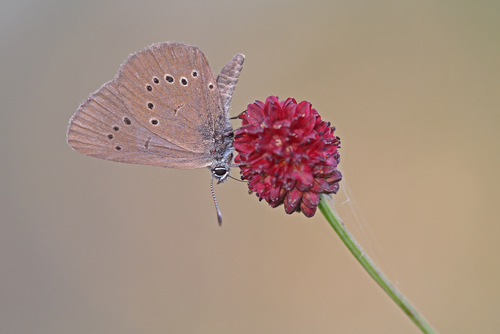
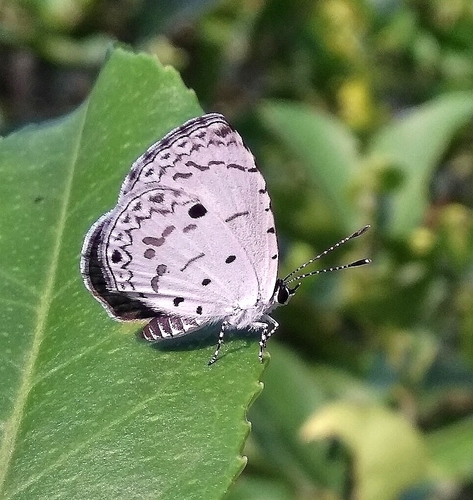
Megisba malaya, the Malayan butterfly, resembles Neopithecops zalmora (the Quaker), particularly in flight. Female Megisba malaya have broader, more rounded forewings than males. This species has distinct wet-season and dry-season forms. For the wet-season form: the upperside ranges from dull, somewhat pale brown to dark brown. Some individuals are nearly uniformly colored, while others have a more or less distinct pale discal patch on the forewing. The hindwing is uniformly colored, with a slender short filamentous tail at the apex of vein 1 that is very often absent. The underside is white. The forewing has the following brown markings: a spot in the cell, a short transverse line on the discocellulars, and a postdiscal curved series of transverse spots or very short bars that cross the wing from costa to dorsum, arranged in irregular echelon relative to one another. This is followed by a slender broken transverse line, a subterminal series of broader transverse spots, and a slender anteciliary line. At the wing apex, markings are diffuse and form a very small brown-shaded patch, while the termini of veins 10, 11 and 12 further inward along the costa each end in a minute brown dot. The hindwing has three spots near the base arranged in a transverse row; a large, conspicuous, rounded subcostal black spot and a smaller similar black spot near the middle of the dorsum. Between these two spots, and along the discocellulars, there are some irregular much paler brown transverse spots on the disc. These are followed, as on the forewing, by an outer postdiscal very slender brown line, a subterminal series of brown or black spots, and a black anteciliary line. The cilia of both forewings and hindwings are white, turning dark brown at the apex of the forewing. Antennae, head, thorax and abdomen are dark brown, with antennae narrowly ringed with white. On the underside, the palpi, thorax and abdomen are snow-white, with the third slender acicular joint of the palpi noticeably brown. The dry-season brood is very similar to the wet-season brood, but the forewing upperside has a large, oval, obliquely placed conical patch that extends from the middle of the dorsal margin to vein 4. In some specimens this white bar or patch continues onto the hindwing. The underside is similar to that of the wet-season form, but all markings are broader, coarser, and more prominent. In some specimens, the forewing's costa and apex are broadly shaded with diffuse fuscous brown. The outer postdiscal brown line forms a series of lunules that extend outward slenderly along the veins and join the anteciliary brown line, enclosing a series of white ground colour spots in the interspaces, each centered with a black or dark brown subtriangular spot. On the hindwing, terminal markings are modified the same way as on the forewing. The spot in interspace 3 of the subterminal series is larger and more prominent than the other spots, and the large subcostal black spot is often broken by an anterior and a posterior silvery spot placed over it. Antennae, head, thorax and abdomen match those of wet-season brood specimens, but are slightly darker on the upperside. Recognized subspecies of Megisba malaya include: Megisba malaya presbyter Fruhstorfer, found in Central and South Nicobars, recorded as rare with unconfirmed validity; Megisba malaya sikkima Moore, found from Kumaon to Myanmar and the Andamans, not rare, and tailed; and Megisba malaya thwaitesi Moore, found in Sri Lanka, South India to Bengal, not rare, and tailless. Tailed and tailless subspecies are sympatric in Sikkim, with the tailed subspecies more commonly found at lower altitudes. Ecologically, the Malayan is a butterfly of evergreen forests. Its caterpillar is light green, vermiform, with swollen middle segments, and feeds on Allophyllus cobbe in the family Sapindaceae. The pupa is thick with blunted ends. Adult butterflies fly low, close to the ground, and are often found in forest glades and forest edges. Males visit cow dung and damp patches for mud-puddling, but generally do not feed on carrion or old fruit, at minimum in Borneo and probably across the species' range.