About Megasoma actaeon (Linnaeus, 1758)
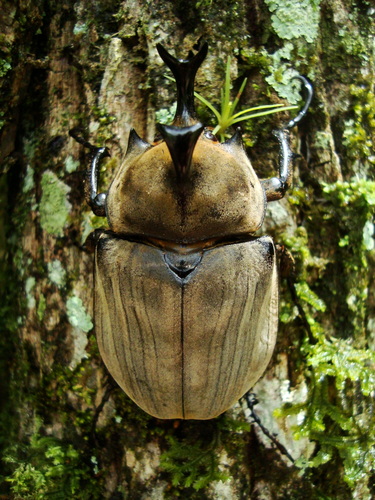
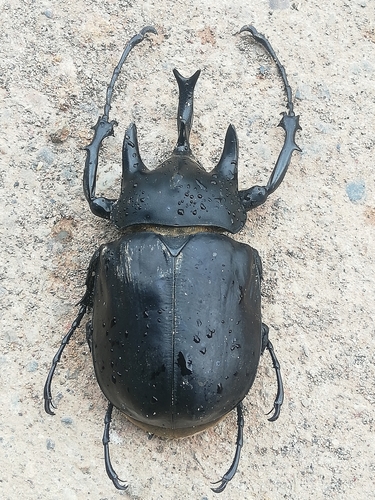
The Actaeon beetle (Megasoma actaeon) is one of the largest beetle species on Earth. Body length ranges from 5–12 centimetres (2.0–4.7 in), with a maximum width of up to 7 centimetres (2.8 in). Mature males can reach over 13.5 centimetres (5.3 in) in length and 4 centimetres (1.6 in) in thickness. The dorsal surfaces of this species are glabrous (hairless), and range in color from matte to shiny black. Actaeon beetles have powerful legs equipped with large tarsal claws. Male beetles have horn-like appendages on both the pronotum and head: the two parallel horns on the pronotum are short, sharp, and point forward, while the head bears a much longer horn with a small tooth. Females lack horns entirely, and have a rugose texture on both the pronotum and elytra. This species is distributed in South America, where it has been recorded in Bolivia, Brazil, Colombia, Ecuador, French Guiana, Guyana, Panama, Peru, Suriname, and Venezuela. During its life cycle, adult females lay eggs into soil when they emerge as adults, and eggs take approximately 9 months to develop. Total larval development and pupation takes almost 3 years to complete. Third instar larvae can reach a weight of 200 grams, the highest recorded weight of any insect larva. The heaviest Megasoma actaeon larva ever recorded was collected in northern South America in 2009; it weighed 228 grams (8.0 ounces), which is nearly the weight of a female rat. Adult beetles are far less massive, and no confirmed adult specimen has exceeded the maximum adult weight recorded for the heaviest adult insect, the Little Barrier giant weta (Deinacrida heteracantha), which can reach up to 71 grams. Adult Actaeon beetles have a documented life expectancy of 100–150 days when kept in captivity.