About Megascops clarkii (L.Kelso & E.H.Kelso, 1935)
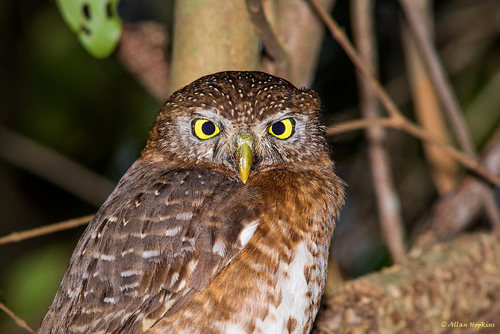
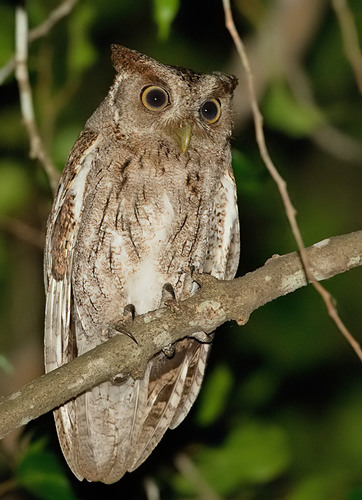
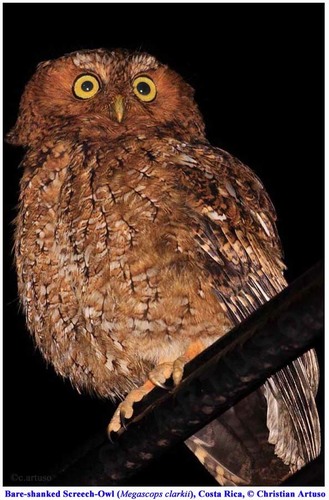
This species of Megascops owl measures 23 cm (9 in) to 25 cm (10 in) in total length (or 173-190 mm) and weighs between 123 and 190 g. Its upperbody is reddish-brown, with black spotting, mottling, and vermiculation. Its hindneck is yellowish, and the shoulder feathers have a black-edged white band across them. Cinnamon-colored bars mark the flight feathers, while the tail has alternating light and dark bars. The underparts are pale brown with a tan and yellowish tint. The upper breast is partially white, and the lower breast and abdomen have either dusky reddish-brown bars, or black-streaked markings. The yellowish-brown facial disc is surrounded by a dark ruff, and the owl has yellow eyes. Its bill is either greenish-grey or bluish-grey. The thighs are mostly yellow, the lower leg is bare, and the yellowish-pink toes are also bare with dark claws. Chicks are whitish; fledglings are cinnamon-colored with white speckles and dusky bars, and are dull yellowish on the underside with yellowish-brown bars. This species is larger than most other Megascops species, which typically occur at lower elevations. It is similar in appearance to the vermiculated screech owl, and the two species sometimes share the same elevation range. Its call consists of steady, short low-pitched whistles, with either the second or third note being the loudest. Female calls have a higher pitch than male calls. This owl inhabits dense humid mountain forests, forest edges, and cloud forests at elevations between 3,000 and 7,600 feet, and occasionally occurs up to nearly 11,000 feet. While it can sometimes be found in thinner upland forests, it requires patchy forest habitat. Its range is restricted to Costa Rica, Panama, and far northwestern Colombia; within Costa Rica, it can be found in the Monteverde Biological Reserve and Volcán Poás National Park. According to a 2017 book, the species has been barely studied and its conservation status is unknown, though the IUCN Red List currently ranks it as least concern.