About Megascops choliba (Vieillot, 1817)
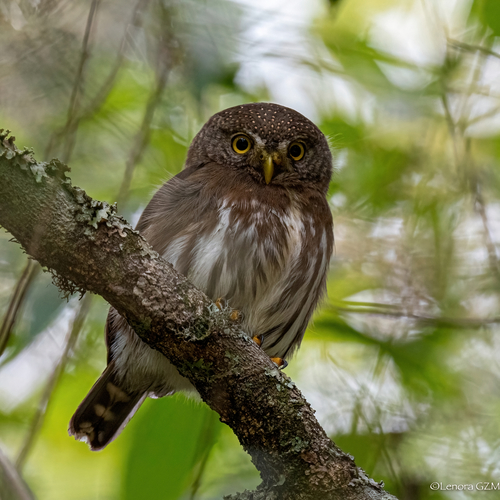
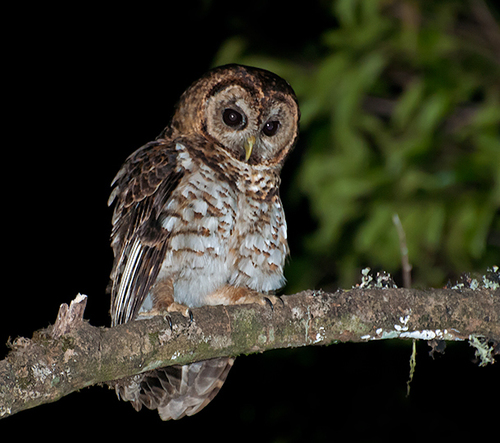
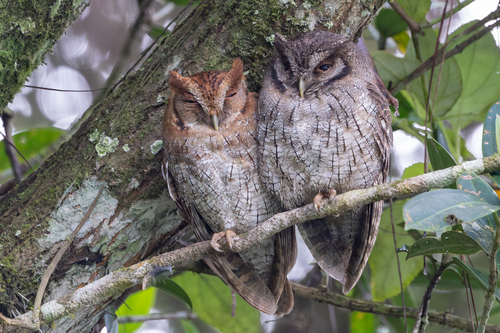
Megascops choliba, commonly known as the tropical screech owl, is polymorphic with extensive color variation. Most individuals are overall gray-brown, while brown or rufous morphs occur less commonly. All morphs have a relatively distinct blackish edge to the facial disc and yellow irises. Their undersides are pale, marked with a black herringbone pattern. Subspecies of this owl differ in color intensity, as well as the amount of black markings on both their upperparts and underparts. Adult tropical screech owls measure 21 to 23 cm (8.3 to 9.1 in) in length and weigh 97 to 160 g (3.4 to 5.6 oz). The tropical screech owl is the most common and widespread screech-owl of the neotropics. It ranges from Costa Rica and Panama south across almost all of South America east of the Andes, including Trinidad and Tobago, but is not present in the far south of the continent. Its eight recognized subspecies have distinct distributions: M. c. choliba occurs from southern Mato Grosso and São Paulo, Brazil, south to eastern Paraguay; M. c. luctisomus is found on the Pacific slope of Costa Rica south to Panama’s Canal Zone, and on the Pearl Islands; M. c. margaritae is restricted to Margarita Island off northern Venezuela; M. c. cruciger is found on Trinidad, and from eastern Colombia and Venezuela east to the Guianas and south to eastern Peru; M. c. duidae occurs on Cerro Duida and Cerro de la Neblina in southern Venezuela; M. c. decussatus is found in central and southern Brazil; M. c. uruguaii occurs in southeastern Brazil, northeastern Argentina, and Uruguay; M. c. surutus is found in Bolivia; and M. c. wetmorei occurs in Paraguay and Argentina. This species occupies a wide variety of landscapes, most of which are partially to mostly open. These include secondary forest, open woodland, coffee plantations, residential areas, and the borders of terra firme and várzea forests. With the exception of M. c. duidae, the tropical screech owl avoids the interior of closed-canopy forests; M. c. duidae inhabits dense forest and bamboo scrub instead.