About Megascops asio (Linnaeus, 1758)
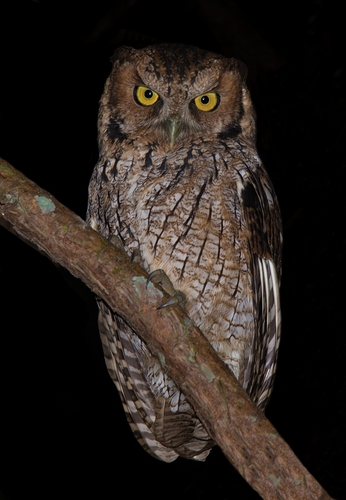
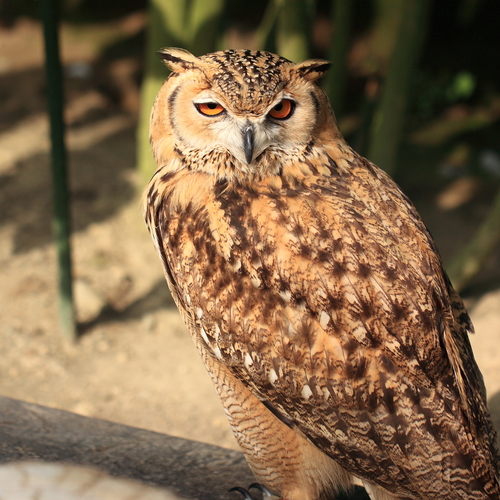
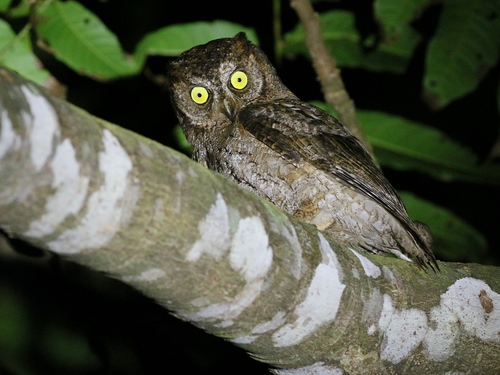
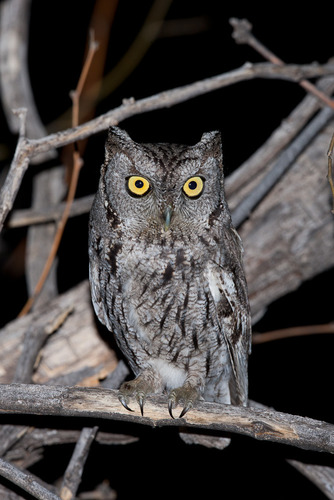
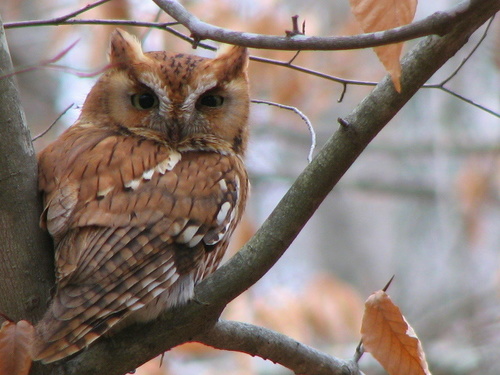
Megascops asio, the eastern screech owl, has the following physical measurements. Adult individuals measure 16 to 25 cm (6+1⁄2 to 10 in) in total length and weigh 121–244 g (4+1⁄4–8+5⁄8 oz). Across its different sized subspecies, average length ranges from 19.5 to 23.8 cm (7+11⁄16 to 9+3⁄8 in). Wingspan ranges from 46 to 61 cm (18 to 24 in). Regional average weight differs by sex: in Ohio, males average 166 g (5+7⁄8 oz) and females average 194 g (6+7⁄8 oz), while in central Texas males average 157 g (5+1⁄2 oz) and females average 185 g (6+1⁄2 oz). Their plumage comes in either rusty or dark gray, with intricate patterning and streaking on the underparts. As a midsized member of the screech-owl group, this species has the stocky build, short tail and broad wings that are typical of its genus. Tail length averages 6.6 to 8.6 cm (2+5⁄8 to 3+3⁄8 in), and wing chord averages 14.5 to 17 cm (5+3⁄4 to 6+3⁄4 in). They have a large, round head with prominent ear tufts, yellow eyes, and a yellowish beak that measures an average of 1.45 cm (9⁄16 in) long. Compared to more southern screech owls, eastern screech owls have relatively large, powerful feet, and their legs and feet are usually feathered all the way down to the toes. Southernmost populations only have remnant bristles on the legs and feet instead of full feathering. Eastern screech owls and their western counterparts are among the heaviest screech owls; the largest tropical screech owls do not exceed them in average or maximum weight. However, due to the eastern screech owl's relatively short tail, several larger species surpass it in total length: Balsas screech owls (M. seductus), long-tufted screech owls (M. sanctaecatarinae), white-throated screech owls (M. albogularis), and rufescent screech owls (M. ingens), in roughly increasing order of length. Bird watchers and ornithologists recognize two main color morphs: red or rufous morphs, and gray morphs. Rusty red morphs are more common in the southern parts of the species' range, and pairings between the two color variants do occur. Gray morphs provide highly effective camouflage against hardwood tree bark, while red morphs are better camouflaged in some pine trees and among the colored leaves of seasonally changing deciduous trees. The highest known proportions of red morphs are in Tennessee, where they make up 79% of the population, and Illinois, where they make up 78% of the population. A rarer brown morph is known, and has only been recorded in the southern United States, specifically Florida. This brown morph may occasionally be produced by hybridization between the two main color morphs. In Florida, brown morphs are typically reported from the more humid areas of the state, and are generally absent from northern and northwestern Florida. A paler gray variation, sometimes nearly washed-out and whitish in appearance, occurs in western Canada and north-central United States. Eastern screech owls live in open mixed woodlands, deciduous forests, parklands, wooded suburban areas, riparian woods along streams and wetlands (especially in drier regions), mature orchards, and woodlands adjacent to marshes, meadows, and fields. They avoid areas where larger owls, especially great horned owls (Bubo virginianus), are regularly active. Their ability to survive in heavily developed areas is greater than that of great horned owls, and far greater than that of barred owls (Strix varia). They are also considerably more successful adapting to urbanization than American barn owls (Tyto furcata) after former farmland is developed. The range of eastern screech owls has expanded into the Great Plains, following the introduction of open woodland and cultivated strips in this region. Eastern screech owls have been recorded living and nesting in unusual sites, including along the border of a busy highway and on the top of a street light in a busy town square. They often nest in trees in human-inhabited neighborhoods and urban yards. In these urban environments, they often get their food from introduced species that live near humans, such as house sparrows (Passer domesticus) and house mice (Mus musculus). They also eat anole lizards and large insects like cicadas. This species occupies the widest range of habitats of any owl found east of the Rocky Mountains. Eastern screech owls roost mainly in natural cavities in large trees, including cavities open to the sky during dry weather. In suburban and rural areas, they may roost in manmade structures such as behind loose boards on buildings, in boxcars, or on water tanks. They also roost in dense tree foliage, usually on a branch next to the trunk, or in dense, scrubby brush. The species' distribution largely overlaps with the range of eastern deciduous woodlands. Its range stops around the Rocky Mountains in the west and northern Mexico in the south, because other screech owls occupy the same ecological niche in those areas. It also stops at the edge of true boreal forest, because other small owls, especially boreal owls (Aegolius funereus), fill the same niche there. Eastern screech owls can be found from sea level up to 1,400 m (4,600 ft) in elevation in the eastern Rocky Mountains, and up to 1,500 m (4,900 ft) in the eastern Sierra Madre Oriental Mountains. Their maximum elevation limit in the Appalachian Mountains, near the center of their range, is not currently known.