About Megarynchus pitangua (Linnaeus, 1766)
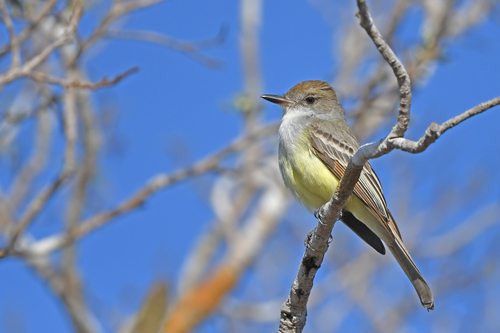
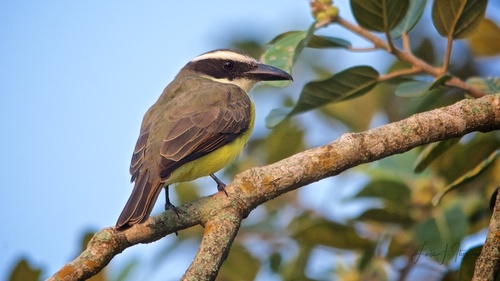
The boat-billed flycatcher (Megarynchus pitangua, originally described by Linnaeus in 1766) measures 21.5 to 24 cm (8.5 to 9.4 in) in length and weighs 53 to 70 g (1.9 to 2.5 oz). Males and females have identical plumage. Adults of the nominate subspecies M. p. pitangua have a blackish brown or sooty crown, with a mostly hidden yellow to orange-rufous patch at its center. They have a wide white stripe above the eye (supercilium) that starts at the forehead and wraps almost all the way around the back of the neck, a wide black stripe extending from the lores (the area between the eye and the base of the bill) to the ear coverts, and white cheeks. Their upperparts are olive to dull brownish olive. Their wings are dusky brownish, and flight feathers usually have thin pale cinnamon or rufous edges. Their tail is dusky brownish, with thin pale cinnamon or rufous edges on the outer feathers. The throat is white, and the underparts are bright yellow. Juveniles do not have the crown patch, have a yellow tint on the supercilium, and have darker, more brownish upperparts and wider cinnamon edges on flight feathers than adults. Other subspecies differ from the nominate and each other as follows: M. p. mexicanus has brighter, more greenish olive upperparts and no rufous on the tail feathers; M. p. caniceps has a grayer crown and more grayish olive upperparts than M. p. mexicanus; M. p. tardiusculus is similar to M. p. mexicanus and M. p. caniceps; M. p. deserticola is also similar to M. p. mexicanus and M. p. caniceps; M. p. chrysogaster has a tawny-orange crown patch, more prominent rufous edges on upperwing coverts and flight feathers, and richer yellow underparts. All subspecies share the species' characteristic long, wide, heavy, arched bill, which is blackish and sometimes has a brownish base to the lower mandible. They have a brown iris and blackish legs and feet. The boat-billed flycatcher is somewhat similar to the great kiskadee (Pitangus sulphuratus) and the social flycatcher (Myiozetetes similis), but it is larger, has a much heavier bill, and has more olivaceous upperparts and browner wings and tail than these two species. The known ranges of each boat-billed flycatcher subspecies are as follows: M. p. tardiusculus occurs in western Mexico, from southwestern Sinaloa south into western Nayarit; M. p. caniceps occurs in southwestern Jalisco in western Mexico; M. p. mexicanus ranges from southern Tamaulipas in eastern Mexico and Guerrero in western Mexico south through Central America (including some offshore islands) into Chocó Department in northwestern Colombia; M. p. deserticola occurs in the valley of the Negro River in central Guatemala; M. p. pitangua occurs in Trinidad; northern, central, and eastern Colombia; most of Venezuela; the Guianas; eastern Ecuador and Peru; all of Brazil south to Rio Grande do Sul; northern and eastern Bolivia; Paraguay; extreme northern Uruguay; and northeastern Argentina south into Corrientes Province; M. p. chrysogaster is found disjunctly west of the Andes, from western Esmeraldas Province in northwestern Ecuador south into Tumbes and northern Piura departments in far northern Peru. The boat-billed flycatcher has also been recorded as a vagrant in Chile. This species inhabits a wide variety of wooded and forested landscapes in tropical and subtropical zones. Most of its common habitats are somewhat open areas, including savanna, clearings with scattered trees, plantations, the edges of continuous forest, and gallery forest. In the Amazon Basin, it is most often found in the canopy of várzea and along the edges of lakes and rivers. It also occurs in mature secondary forest and well-shaded gardens. In terms of elevation, the boat-billed flycatcher is generally found between sea level and 1,500 m (4,900 ft) in Mexico and Central America, but locally reaches 1,850 m (6,100 ft) in northern Central America and 2,200 m (7,200 ft) in Costa Rica. It reaches 1,400 m (4,600 ft) in Colombia, 1,300 m (4,300 ft) in Ecuador, and 1,200 m (3,900 ft) in Peru. In Venezuela it is mostly found below 1,000 m (3,300 ft) but reaches about 1,900 m (6,200 ft), and in Brazil it occurs below 1,500 m (4,900 ft).